




Why Bar Stores Run Last In, First Out
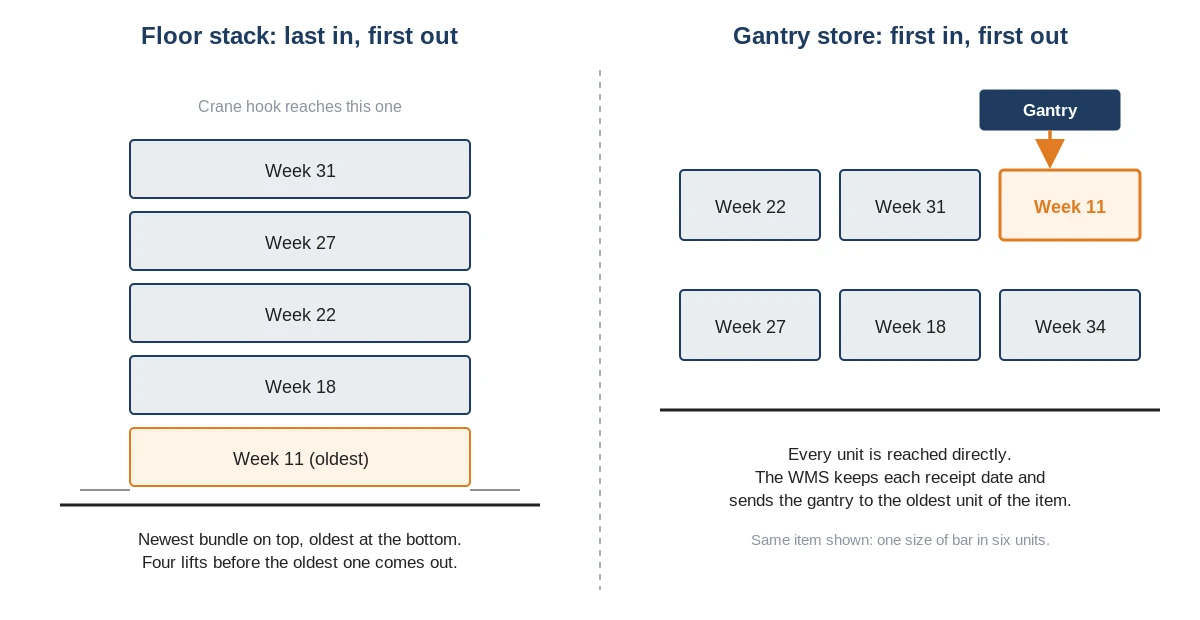
Gravity decides the order in most long goods stores. On the floor, a new delivery lands on the pile, and the bundle underneath waits until everything above it is used. On a crane-served cantilever rack, the newest bundle on an arm usually sits on the outside, closest to the hook.
Nobody plans last in, first out (LIFO). It happens because reaching the old bundle costs extra crane lifts. The result is a layer of stock that may sit in the corner of the hall for years.
What Ageing Stock Costs a Metal Shop
Old bar is not always bad bar, but it causes three kinds of trouble. Bright and ground bar can rust when it sits for months in a humid hall. Stock that nobody can see gets bought again. Mill certificates for old heats get separated from the material they describe.
Coated and anodised profiles add one more point. Customers expect the same finish across a job, and a forgotten bundle from an older batch may not match.
How the Store Picks the Oldest Unit
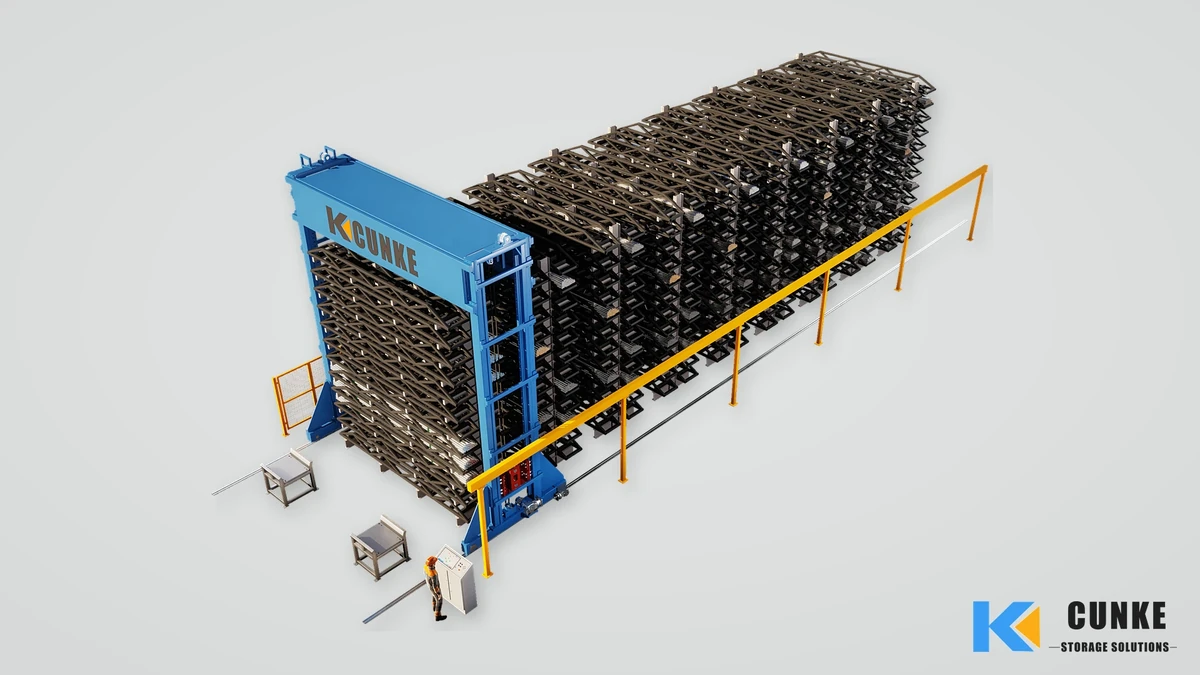
At goods in, the operator scans the bundle and the WMS stores it with its receipt date. The gantry puts the storage unit in any free location. Location and age are independent, so the store does not need to be loaded in order.
When an order asks for an item, the WMS looks at every unit holding it and offers the oldest. The gantry brings that unit to the loading station. Stock-age alerts list units that have passed the limit you set, so purchasing sees slow items before they become dead stock.

One Delivery per Storage Unit
FIFO in the WMS works at storage unit level. If a half-empty unit is topped up with a new delivery, the old bars and the new bars become one record. The WMS can no longer tell which bars arrived first.
The rule we recommend is simple: one delivery, or one heat, per unit. The price is more storage locations, because some units run part-full. We count that in when we size the racks from your stock list.
Partly used units go back to the store with their original receipt date, so they keep their place in the rotation.
When Strict FIFO Is Not Wanted
Strict FIFO is not always what production wants. A customer may ask for a named heat. A sales order may reserve material from a specific delivery. An opened unit may be preferred over a full one.
Which exceptions the WMS should handle, and how, is assessed for each project before we quote. We check them against your ERP or MES connection, because purchase and sales data usually live there.
Specifications
The "typical" figures below come from CK stores already in use. The values for your own store appear on your layout drawing.
|
Group |
Item |
Value |
|
Capacity |
Load per storage unit |
Up to 5,000 kg (11,000 lbs); usually 3,000 kg (6,600 lbs) for 6 m and 5,000 kg (11,000 lbs) for 12 m material |
|
Dimensions |
Storage unit length |
Material length plus about 50 mm (2 in) at each end |
|
Dimensions |
Gantry height |
Up to 10 m (32.8 ft) |
|
Dimensions |
Rack height |
7 to 8 m (23 to 26 ft) |
|
Operation |
Gantry travel speed |
Up to 25 m/min (82 ft/min), typical |
|
Operation |
Positioning |
±2 mm to ±5 mm, typical |
|
Software |
Allocation |
First in, first out by receipt date; exceptions agreed per project |
|
Software |
Alerts |
Stock-age and reorder alerts |
|
Software |
Records |
Location of every storage unit, stock counts, handheld barcode terminals |
|
Software |
ERP or MES link |
Assessed for each customer system |
For indoor use. Load ratings are per storage unit and are confirmed for each project.
Fixed or Mobile Racks for a FIFO Store
With fixed cantilever racks, every unit faces an open aisle and the gantry picks the oldest unit at once. With mobile cantilever racks on floor rails, the rows close up and only one aisle is open at a time.
In a mobile store, the oldest unit may sit behind a closed aisle, and the rows must move before the gantry can reach it. Strict FIFO therefore means more aisle changes. We plan the item locations with that in mind. A looser rule, such as taking an older unit from the open aisle, is assessed per project. A 6 m store on mobile racks shows that layout.
FIFO Options Compared
|
Storage method |
Reaching the oldest bundle |
Record of age |
|
Floor stack |
Only after the bundles above it are moved |
Tags and memory |
|
Crane-served roll-out cantilever rack |
Roll out the level, then lift past newer bundles on the same level |
Tags and memory |
|
Gantry store, fixed racks |
Direct, one gantry move |
WMS receipt date per unit |
|
Gantry store, mobile racks |
Direct after the right aisle is opened |
WMS receipt date per unit |
If your stock turns over within days, rotation hardly matters and roll-out cantilever racks may be the better buy. The same applies to a store with a few sizes that are always used in full bundles.
Delivery and Support
Delivery takes 60 to 90 days from order. That covers inspection, trial assembly and testing in our factory, and export packing. An engineer commissions the store on site. The warranty is 1 year and can be extended. We are CE certified and hold ISO 9001:2015 and ISO 14001:2015 certificates. More layouts are in our automated long material storage range, and you can watch a gantry store at work on our main site.
FAQ
Plan a FIFO Store for Your Bars and Profiles
Tell us the points below, and we return a store layout, a storage unit count and a price.
- Item list: sections, sizes, lengths and tonnes per item
- Deliveries per month and typical bundle weight
- How long stock stays today, and which items age or rust
- Rules you need besides FIFO: heats, reservations, opened units
- Hall drawing with clear height and crane runways
- ERP or MES in use
Ask for a FIFO store layout and quote.
Hot Tags: automated fifo storage for bars and profiles with gantry robot, China automated fifo storage for bars and profiles with gantry robot manufacturers, suppliers, factory