




Product Overview
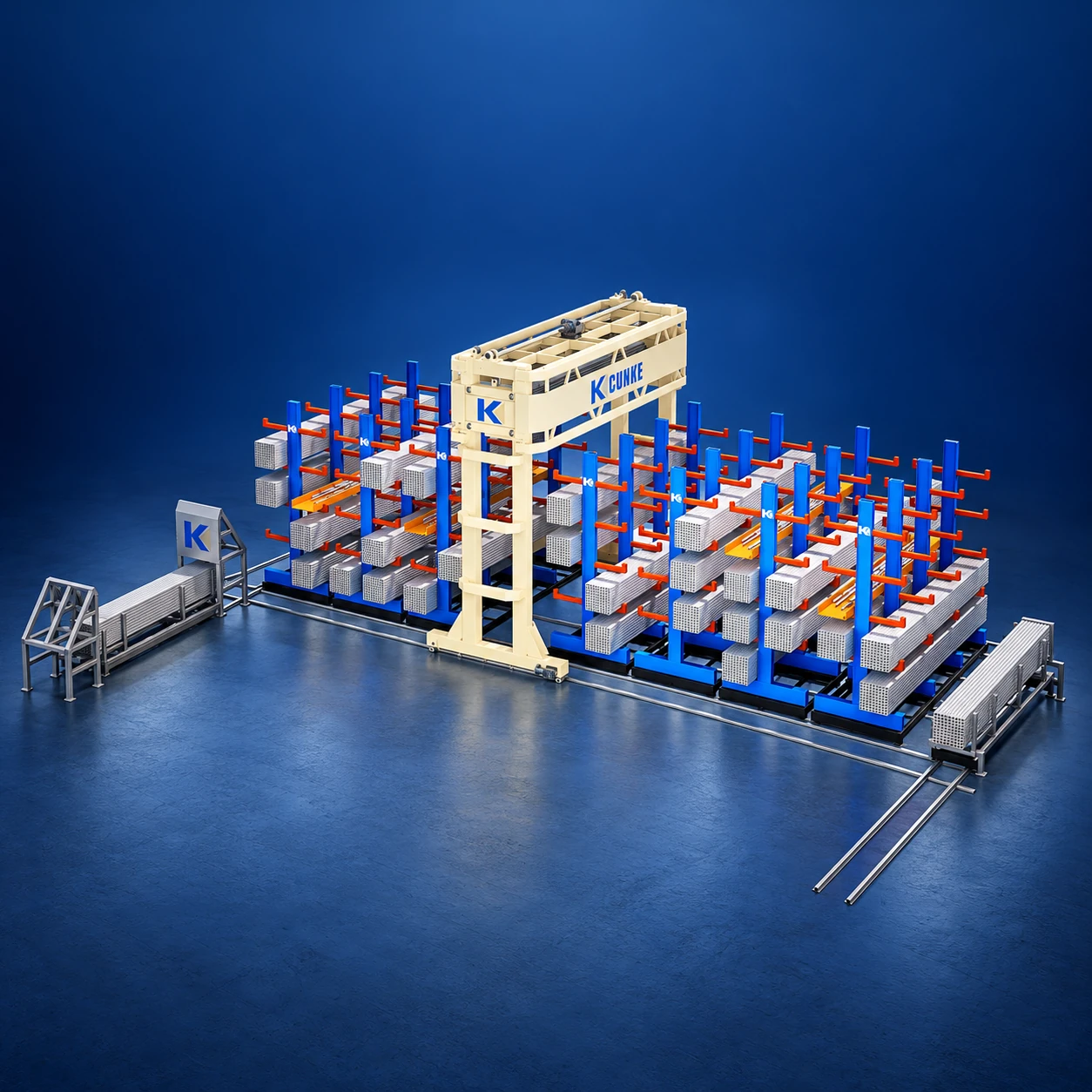
This 6 m automated long material storage system combines motorized mobile cantilever racks with a travelling gantry. CK METAL STORAGE SOLUTIONS offers a typical 6 m (19.7 ft) / 3,000 kg (6,600 lb) configuration for carrier-based storage, designed around the stock and site. It suits profile stores supplying cutting or fabrication where the number of stock positions matters alongside access frequency.
Mobile bases move whole rack rows along rails to open one shared working aisle at the required location; the gantry retrieves a loaded carrier to a transfer position. The 3,000 kg rating applies to the specified storage unit. Its treatment of carrier self-weight must be stated in the quotation before you calculate the usable material payload.
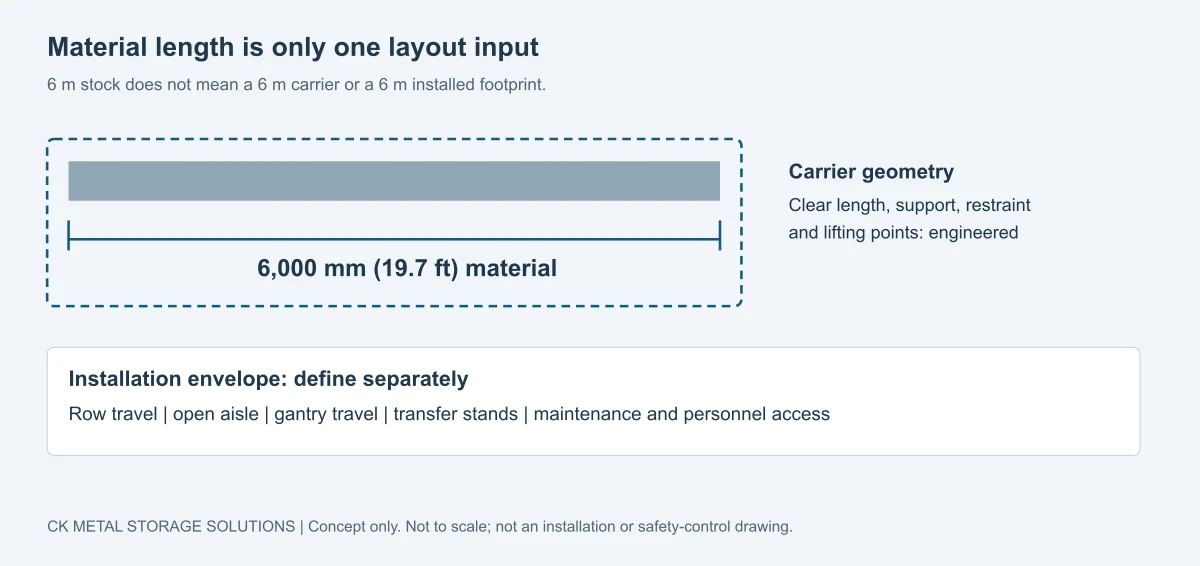
- 6 m material length; carrier length and installed footprint are separate dimensions.
- 3,000 kg typical rated load per storage unit, subject to the agreed load and carrier specification.
- Motorized mobile rack bases, coordinated with gantry carrier handling.
- Transfer-station access for the next production task; single-piece separation is a separate operation.
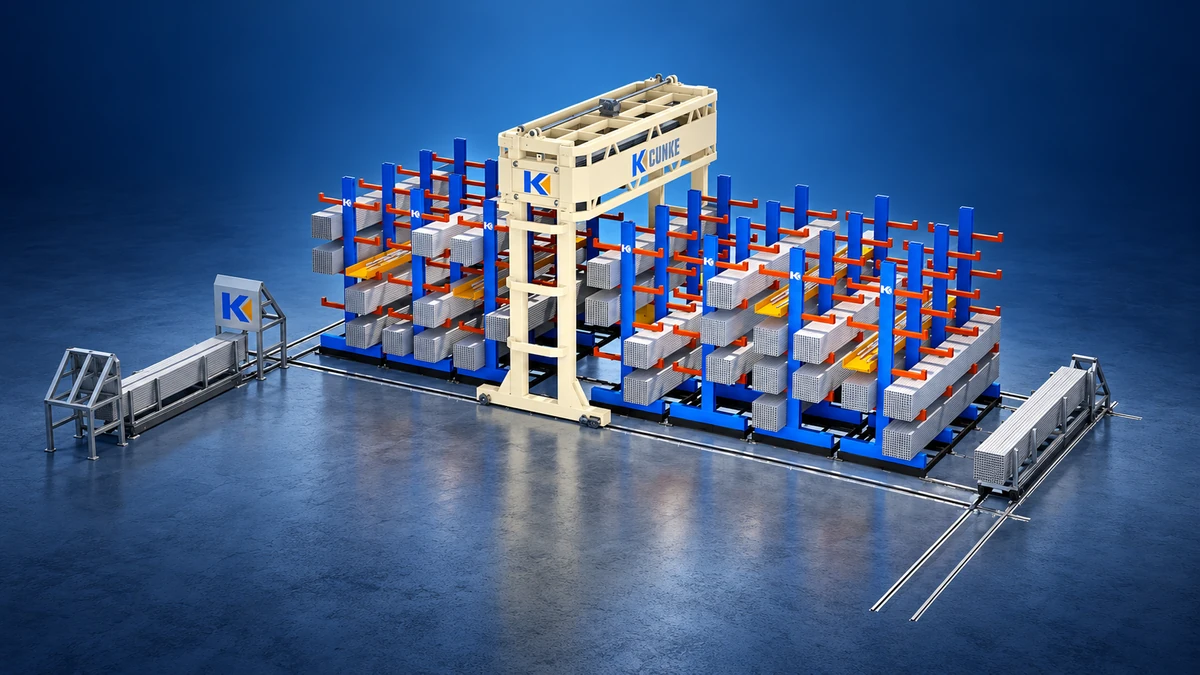
Engineering renderings illustrate the mobile-rack arrangement and an ivory gantry colour option. They are not installation photographs or proof of a completed 6 m / 3 t project. Paint references can be agreed against a RAL colour chart.
Open the target aisle before retrieving the carrier
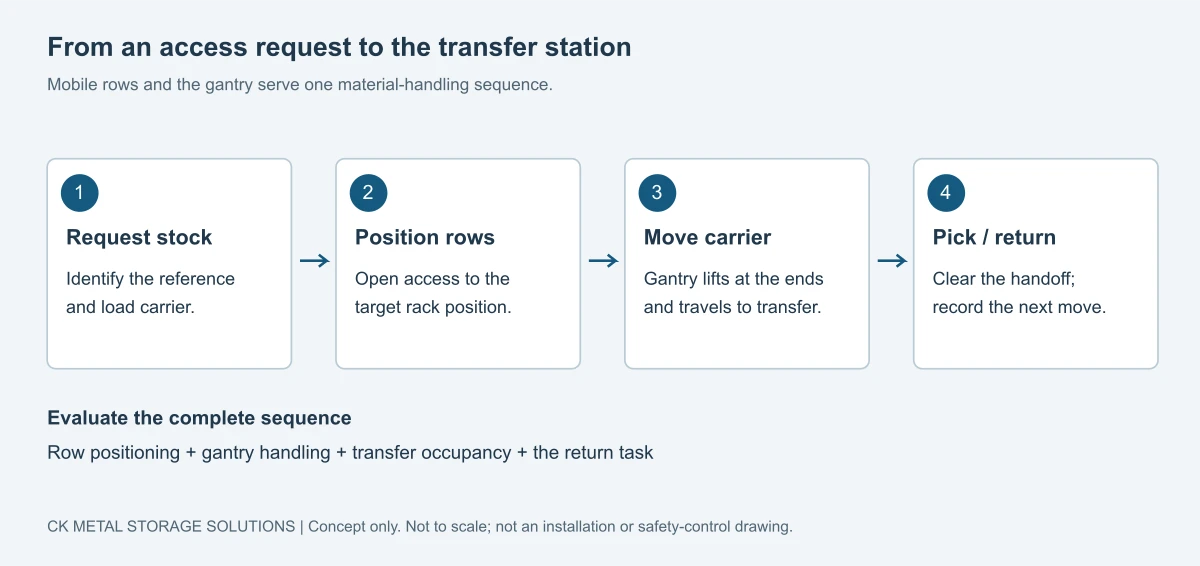
The racks move on bases to provide access at the requested location. The gantry then lifts the carrier at its ends and transports it to the receiving station. Loading reverses this material route: a prepared load enters at the loading position and is deposited at its assigned location.
Row positioning, gantry movement and the transfer position belong to the same handling sequence. A rack location can hold the right stock while the receiving position is still occupied by the previous job. Include that occupied time when planning how the store will supply production.
Judge the layout against your busiest retrieval sequence
Daily retrieval totals can hide the task that matters: several different sections requested close together. For example, a saw may need three profile references while another job returns unused stock. Use your actual job list to show the order of those requests, where the stock is stored and how long each carrier remains at the transfer position.
For a mobile layout, review the time needed to open each target aisle as well as the gantry journey. Grouping work by stock reference may reduce repeated access changes, but only if the cutting schedule allows it. This is a planning choice to discuss, not a promise that the controller automatically batches your orders.
This configuration is worth considering when more stock positions in the available floor area justify coordinated access. If production needs frequent independent access at several locations, compare a fixed-rack arrangement before choosing the mobile layout. We do not quote a retrieval rate from travel speed alone.
Proposal basis for the 6 m mobile configuration
|
Group |
Item |
Proposal basis |
|
Capacity |
Material length |
6 m (19.7 ft), typical configuration |
|
Capacity |
Rated load |
3,000 kg (6,600 lb) per specified storage unit; carrier self-weight basis to be defined |
|
Arrangement |
Rack access |
Motorized mobile cantilever rows open the target aisle |
|
Handling |
Load movement |
Gantry lifts and transfers the carrier at its ends |
|
Control |
Inventory / interfaces |
Warehouse management functions; ERP/MES scope assessed for the customer system |
|
Layout |
Installed dimensions |
Derived from carrier geometry, row travel, gantry movement and transfer access |
The rating is not a per-arm capacity or the total allowable mass of a complete row. Provide section drawings, length range, piece count and the heaviest intended carrier load. The proposal must also define the permitted distribution and restraint of the stock.
Take the required pieces at the transfer station
Carrier retrieval brings the load to the handoff position. Decide how the required pieces leave it: removal by your team, lifting equipment, or a separately designed connection to the next machine. Automatic storage does not establish single-bar separation or automatic saw feeding.
In an aluminium extrusion store, the same section may have different finishes or packaging. Identify those differences in the stock list and describe the contact surfaces needed during storage and picking. Aliplast Extrusion's profile storage guidance stresses dry storage, separation and careful support. A denser rack layout does not replace those material-handling requirements.
After a partial pick, the remaining full-length stock must still fit its agreed support and restraint arrangement. List cut remnants separately, including the shortest length you want to keep. They need an agreed storage route; spare space in a carrier is not evidence that it can carry every short offcut.
Compare fixed aisles with one shared mobile aisle
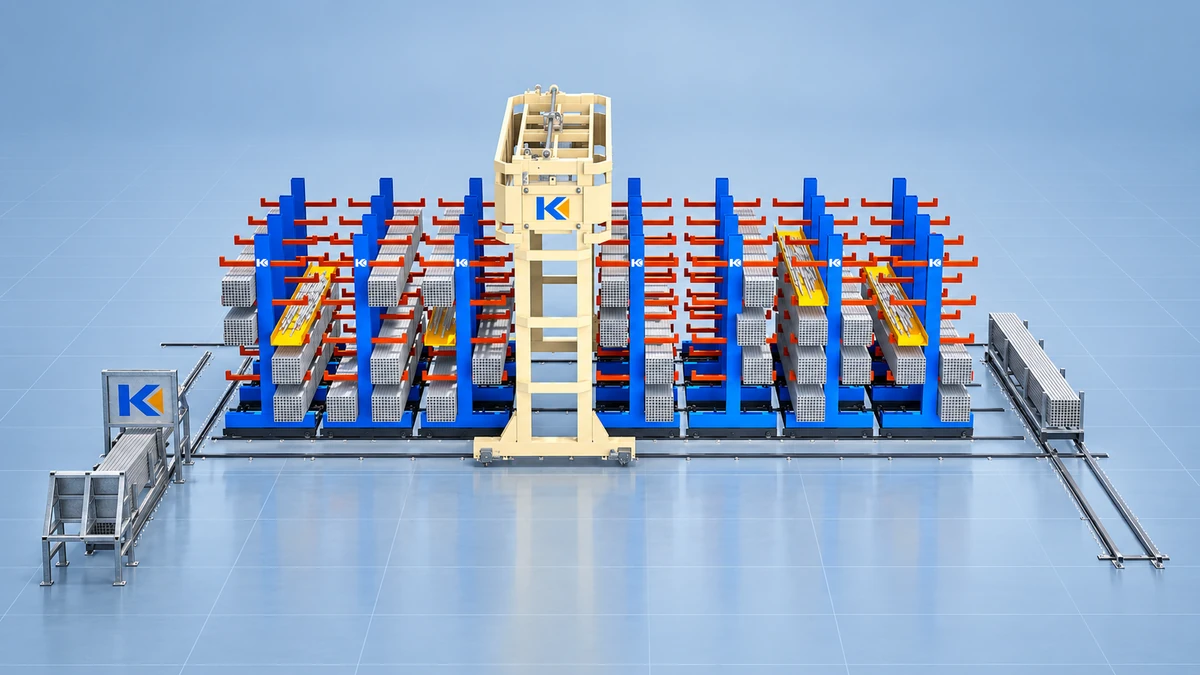
Both arrangements use ordinary cantilever arms. The arms do not extend or roll out. The difference is how the rack rows are installed and how the gantry gains access to the requested carrier.
|
Arrangement |
What moves |
Aisle layout |
What to compare |
|
Fixed cantilever racks with a gantry |
The racks are anchored to the floor; the gantry handles the carrier |
An access aisle remains between each rack group |
Permanent aisle space and the access sequence needed by production |
|
Mobile cantilever racks with a gantry |
Rail-guided bases move whole rack rows; the arms remain fixed to their uprights |
One shared working aisle opens at the requested location |
Row repositioning, gantry handling and transfer-station occupancy |
Choose the fixed arrangement when permanent aisles better suit the stock access plan. Consider the mobile arrangement when consolidating those aisles into one shared opening is worth the row-positioning step. Neither arrangement uses extending rack levels to present the load.
Fixed and mobile gantry arrangements are outlined in our automated storage configuration overview. Ask for a comparison using the same stock list and retrieval sequence so the proposals answer the same production requirement.
Keep the moving area separate from the picking area
Personnel must remain outside the operating aisle and moving equipment area during automatic work. Plan stock removal at the transfer position, with the access procedure and control response included in the project specification. An aisle-entry alarm is optional; its presence must not be assumed to mean an automatic protective stop.
Mark the floor rails, full row travel, gantry clearance, service access and transfer equipment on the site drawing. Include columns, the lowest overhead obstruction and any forklift or crane route crossing the handoff area. Embedded and surface-mounted rails are available approaches; foundation and floor reactions follow the engineered layout.
Questions about daily operation
Send a stock list and one busy-hour example
For a 6 m automated long material storage proposal, send CK METAL STORAGE SOLUTIONS your longest and shortest stock, section drawings, finishes, packaging and heaviest load. Add the number of references, inventory per reference, a busy-hour retrieval and return sequence, and the equipment used at the transfer position.
With your site drawing, floor information and power supply, we can develop a layout and quotation. Electrical demand, carrier dimensions, aisle width and the installed envelope are established during that work.
Automated projects normally require 60–90 days, including inspection, trial assembly, commissioning work and export packing. Supply includes assembly manuals, videos and engineer support for site commissioning. The standard warranty is one year, with an after-sales response within 24 hours.
Request a layout and quotation with the stock list, site photos and retrieval example.
Hot Tags: 6 m automated long material storage with mobile cantilever racks, 3,000 kg rated load, China 6 m automated long material storage with mobile cantilever racks, 3,000 kg rated load manufacturers, suppliers, factory