


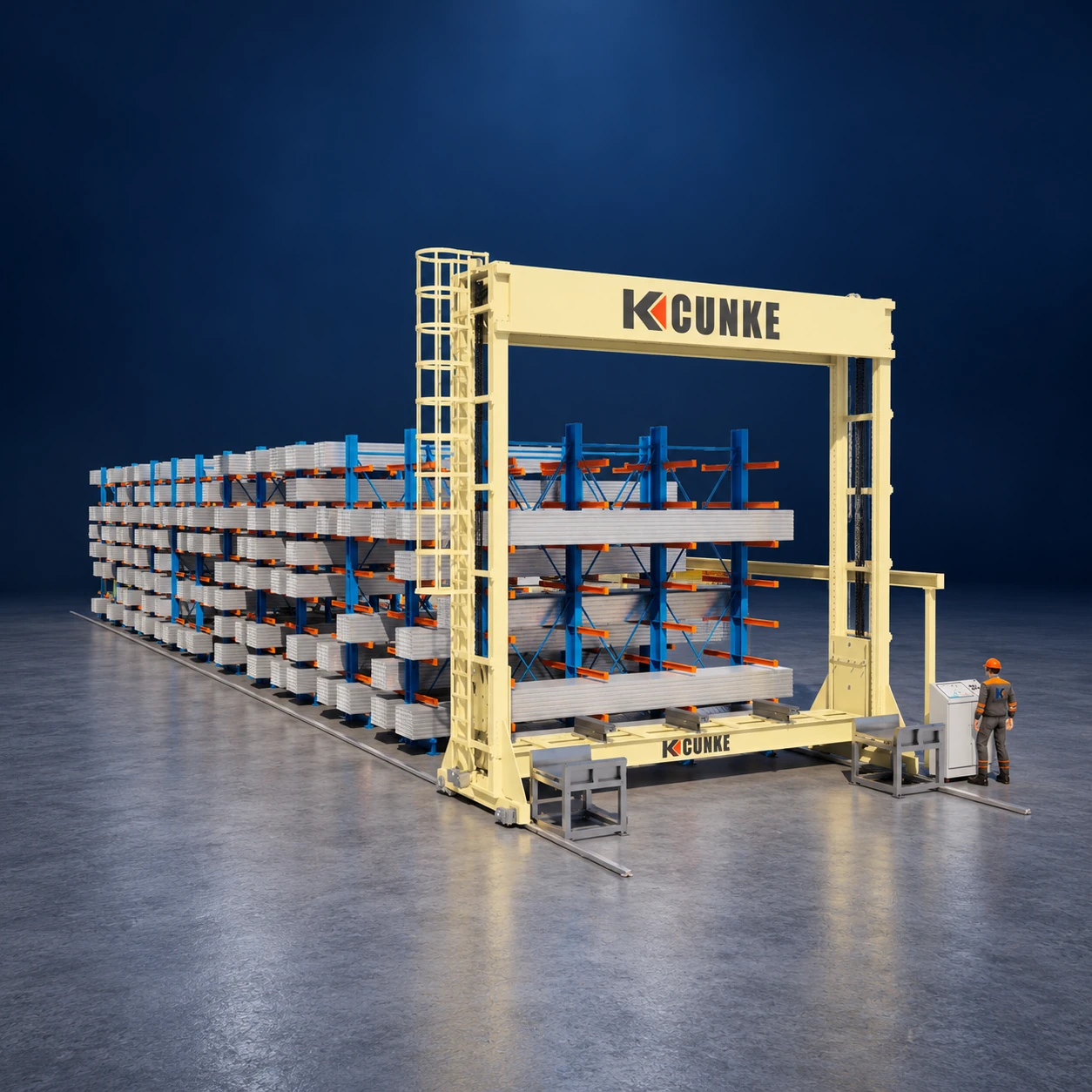


Product Overview
The CK METAL STORAGE SOLUTIONS 6 m gantry storage system combines fixed cantilever racks with a rail-mounted gantry robot for long profile storage. A typical configuration handles 6 m (19.7 ft) material with a 3,000 kg (6,600 lb) rated load per storage unit. The system suits profile processors and metal stockholders that need selected loads delivered to a defined transfer station.
- 6 m (19.7 ft) material length: size the carrier around the stock, including end clearance.
- 3,000 kg (6,600 lb) typical storage-unit rating: confirm the material and carrier weights in the quotation.
- Fixed rack rows: the gantry moves between storage positions while the racks remain stationary.
- Load-carrier retrieval: plan the separate handling step between the transfer station and your processing equipment.
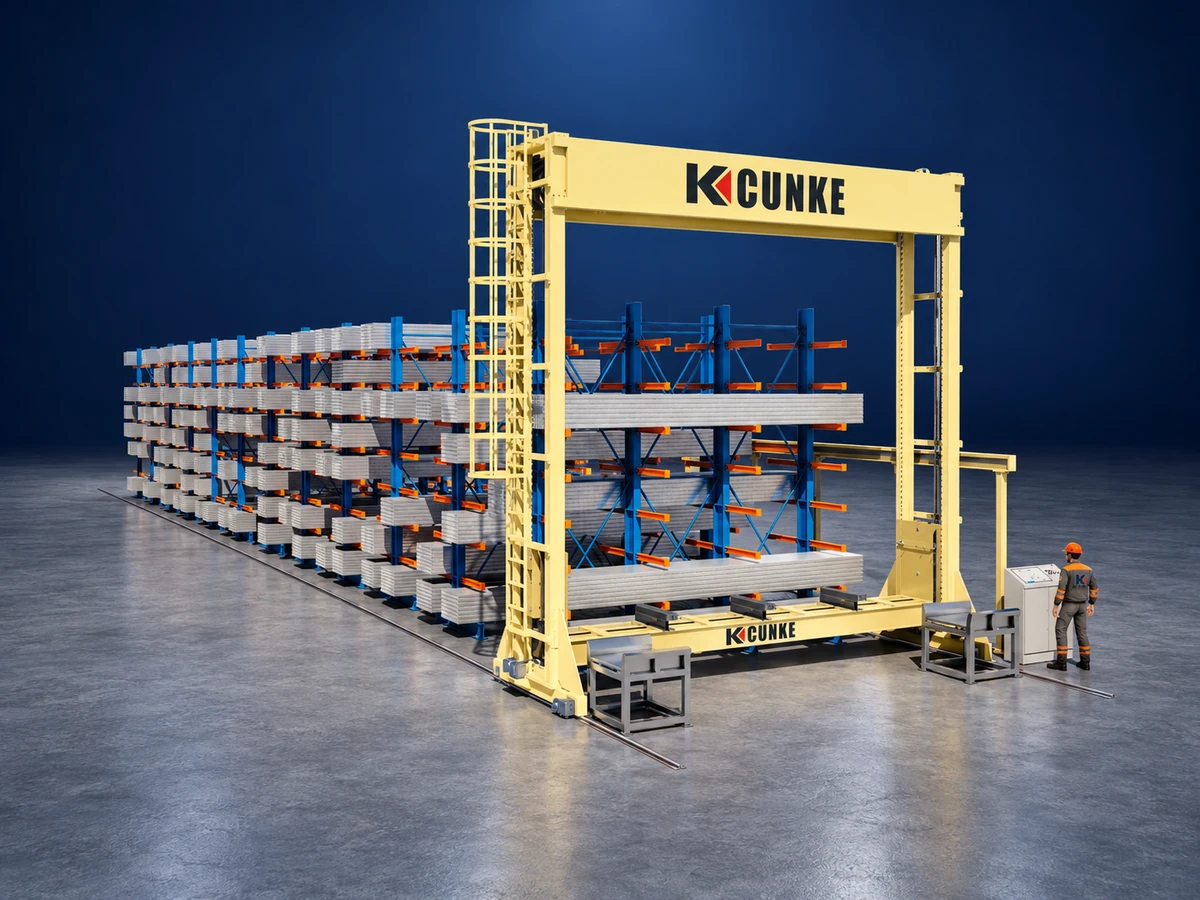
Rendered fixed-rack arrangement. Carrier geometry, rack layout and final ratings are defined for each project.
Specifications for the 6 m fixed rack configuration
The 6 m gantry storage system is specified around your carrier loads and site layout, rather than a single standard warehouse footprint.
|
Group |
Item |
Configuration |
|
Capacity |
Material length |
6 m (19.7 ft) for this configuration |
|
Capacity |
Typical rated load |
3,000 kg (6,600 lb) per storage unit; rating basis defined in the project specification |
|
Dimensions |
Carrier clear length |
Sized for the material and agreed end allowance |
|
Dimensions |
Carrier width and support spacing |
Designed from bundle cross-section, material stiffness and actual load |
|
Dimensions |
Rack height and overall envelope |
Specified in the project layout, including the gantry travel and transfer station |
|
Operation |
Storage structure |
Fixed cantilever racks with a rail-mounted gantry robot |
|
Operation |
Load movement |
Gantry lifting platform supports the load carrier at its ends |
|
Controls |
Inventory and system interface |
WMS scope and ERP or MES connection assessed for the project |
|
Construction |
Surface finish |
Powder coating; paint or galvanizing options assessed for the environment |
The 3,000 kg figure is a storage-unit rating, not a rating for each individual cantilever arm. The final specification must identify whether carrier tare is included. No travel speed alone defines the number of complete retrievals per hour.
When fixed racks fit your material flow
Fixed cantilever gantry storage fits a planned long-stock area where selected carriers must reach a controlled handoff position.
- Choose this configuration when your main stock is 6 m long and the proposed carrier loads fit the specified rating.
- Consider fixed rows when the approved layout can accommodate permanent rack positions and the gantry movement envelope.
- For aluminum profile processing, include the surface condition and handling contact requirements in the carrier review.
The configuration is unsuitable when you expect the storage robot alone to separate individual bars or feed any existing machine automatically. A separate loading interface needs assessment. A simpler crane-served rack may be appropriate when you prefer direct manual access to individual levels.
How the gantry stores and retrieves a carrier
The gantry transfers a load carrier between the station and a selected position on the fixed cantilever racks.
- An operator or external handling device places the prepared load at the agreed transfer station.
- The control system receives the storage instruction and identifies the destination.
- The gantry approaches the carrier and lifts it using the end supports.
- The gantry travels to the selected location and places the carrier on the rack supports.
- For retrieval, the gantry brings the selected carrier back to the transfer station.
People must remain outside the equipment working area during operation. An aisle-entry alarm is an optional configuration. The site safety design must define access procedures and protective measures. During a power failure, manual extraction is not an operating backup.
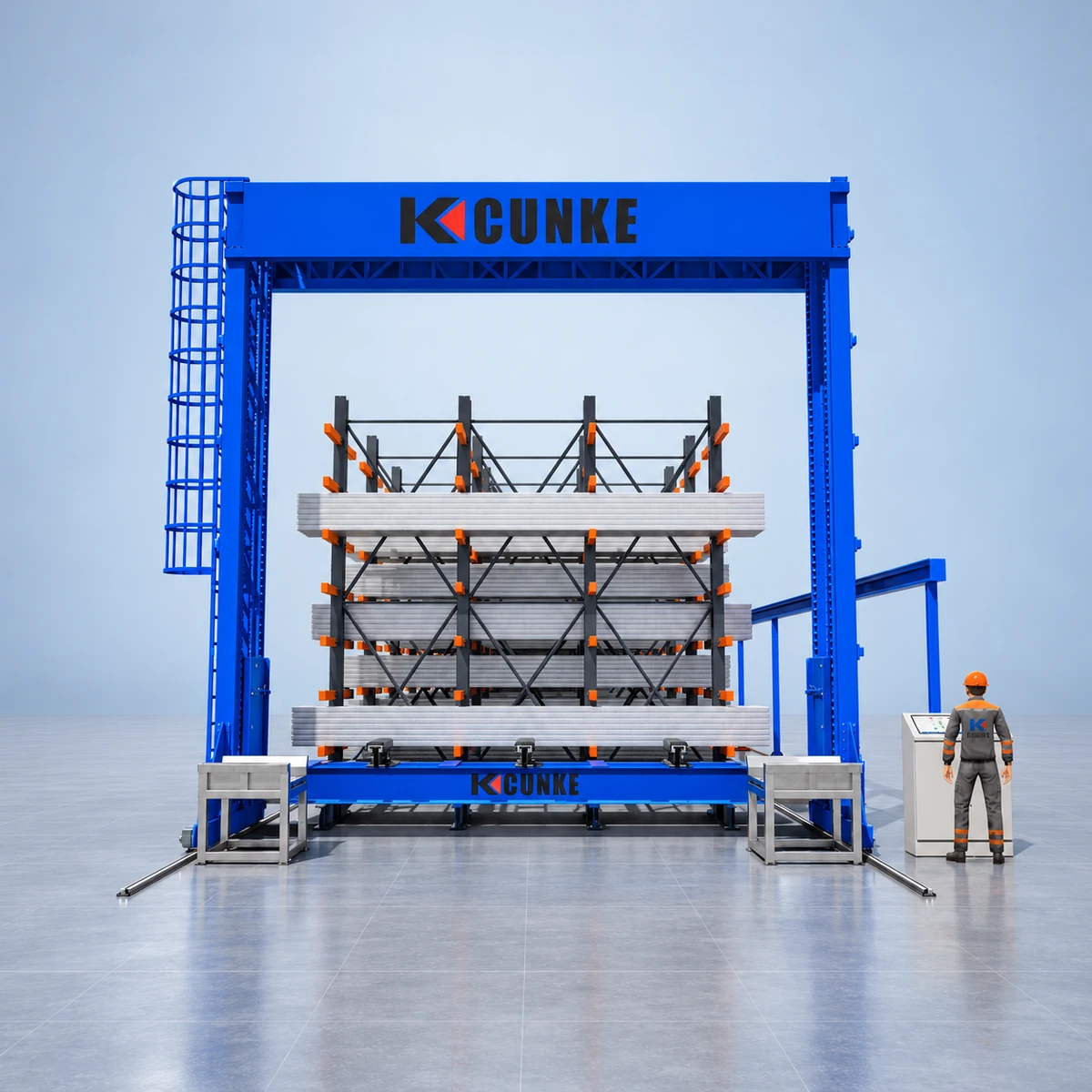
Front view with a different colour option. Both product views are renderings, not installation photographs.
Define the handoff before choosing the layout
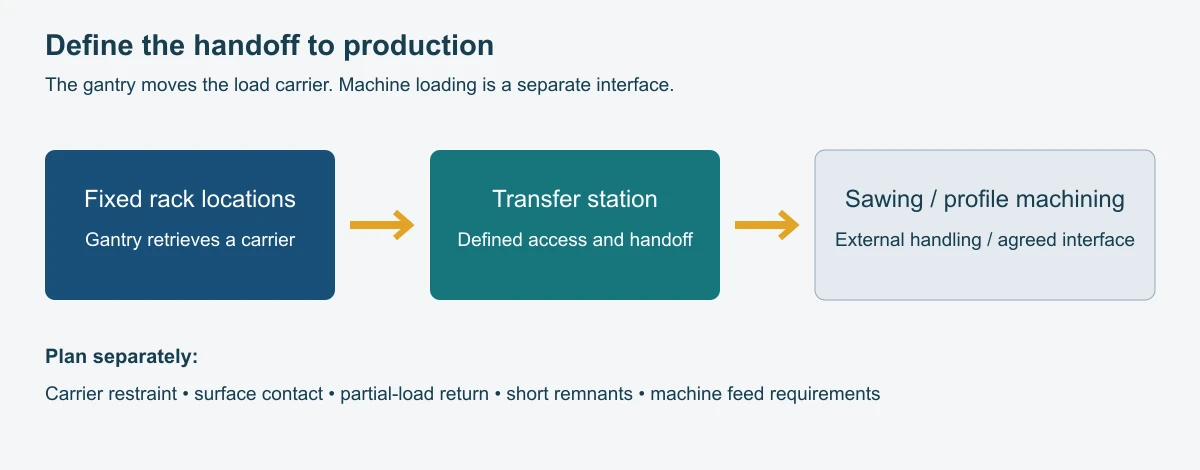
The transfer station must suit the next production step, whether you prepare long profiles for sawing, drilling or milling.
A profile machining line may require individual bars, while the storage gantry delivers a carrier. Identify who removes the required material and where remaining full-length stock returns. Do not assume short remnants can use the same carrier or support arrangement.
For coated or anodized profiles, send the required surface condition and contact restrictions with your enquiry. Review carrier support and restraint against the actual section, rather than selecting a carrier by weight alone.
Allow clearance beyond the material length
The carrier needs end clearance beyond the nominal 6 m material length to reduce end contact during handling.
Our sales guidance recommends approximately 50 mm (2 in) at each end. The dimension sketch shows the material and end allowance only. Carrier clear length, frame construction and support positions remain part of the engineered design.

Compare storage and retrieval methods
Choose the retrieval method around your handling equipment, access needs and production handoff.
|
Option |
What moves |
Material access |
Selection consideration |
|
This fixed-rack gantry configuration |
Gantry and carrier; rack rows stay fixed |
Carrier presented at the transfer station. |
Plan the permanent rack layout and carrier interface |
|
Arms extend by hand crank; crane handles material |
Access at the extended level |
Useful when you retain an operator-led crane workflow |
|
|
Arms extend by motor; crane handles material |
Access at the extended level |
Motorized arm extension remains separate from automated carrier retrieval |
We also design gantry layouts with mobile rack bases. Compare fixed and moving rack arrangements in the our gantry storage configuration overview . The operating sequence and site layout need separate assessment.
Configuration options for your stock
The carrier, rack layout and transfer arrangement are developed from your material and handling requirements.
- Provide maximum and minimum stock lengths, bundle width and height, and actual material weight.
- Specify the required inventory information and whether the system must exchange data with ERP or MES.
- Request a review of the rail installation method and the transfer-station arrangement.
- Available in RAL colours; the main rendering shows RAL 5012 / RAL 7016 rack colours. The yellow gantry remains a separate visible component.
Site preparation and installation
A fixed-rack project needs an agreed layout and foundation assessment before rail and rack installation.
Provide the column grid, lowest roof obstruction, usable floor area, access routes and proposed transfer location. Allow for the full gantry travel and load movement envelope. Rack footprint alone does not describe the occupied operating area.
Rail mounting can be surface-mounted or embedded, depending on the approved civil design. Confirm rack reactions, rail reactions, floor construction and electrical supply for the selected configuration. A floor-load value or power figure from a smaller installation is not a design value for this system.
The installation sequence includes foundation checks, setting out, rails, gantry assembly and rack installation. On-site commissioning and operator training follow the project plan.
Delivery and support
Our automation projects normally require 60–90 days, depending on project complexity, including inspection, trial assembly, commissioning and export packing.
Equipment ships in sections with manuals and installation videos. An engineer supports on-site commissioning, typically for about one week. The overall installation period is agreed separately for the site.
The standard warranty is one year, with an extension available by agreement. We provide spare wear parts with shipment and responds to after-sales enquiries within 24 hours. Structural engineering includes FEA verification, followed by pre-shipment assembly and functional testing.
CK METAL STORAGE SOLUTIONS is ISO 9001:2015 and ISO 14001:2015 certified. Profile rack designs use China utility model patents. Request the applicable product compliance documents with the configuration proposal.
Questions about this configuration
Request a 6 m fixed rack gantry layout
Send your material list, maximum and minimum lengths, bundle cross-sections, heaviest loads and required storage quantity. Include surface requirements, daily retrieval demand, shift pattern and downstream equipment details.
Add a floor plan with columns, clear height, available area and access routes. Send your material and site details to our team for a proposed layout and a configuration-based quotation.
Hot Tags: 6 m gantry storage system,fixed cantilever gantry storage,3,000 kg profile storage,automated long goods storage,gantry profile storage,load carrier handling