


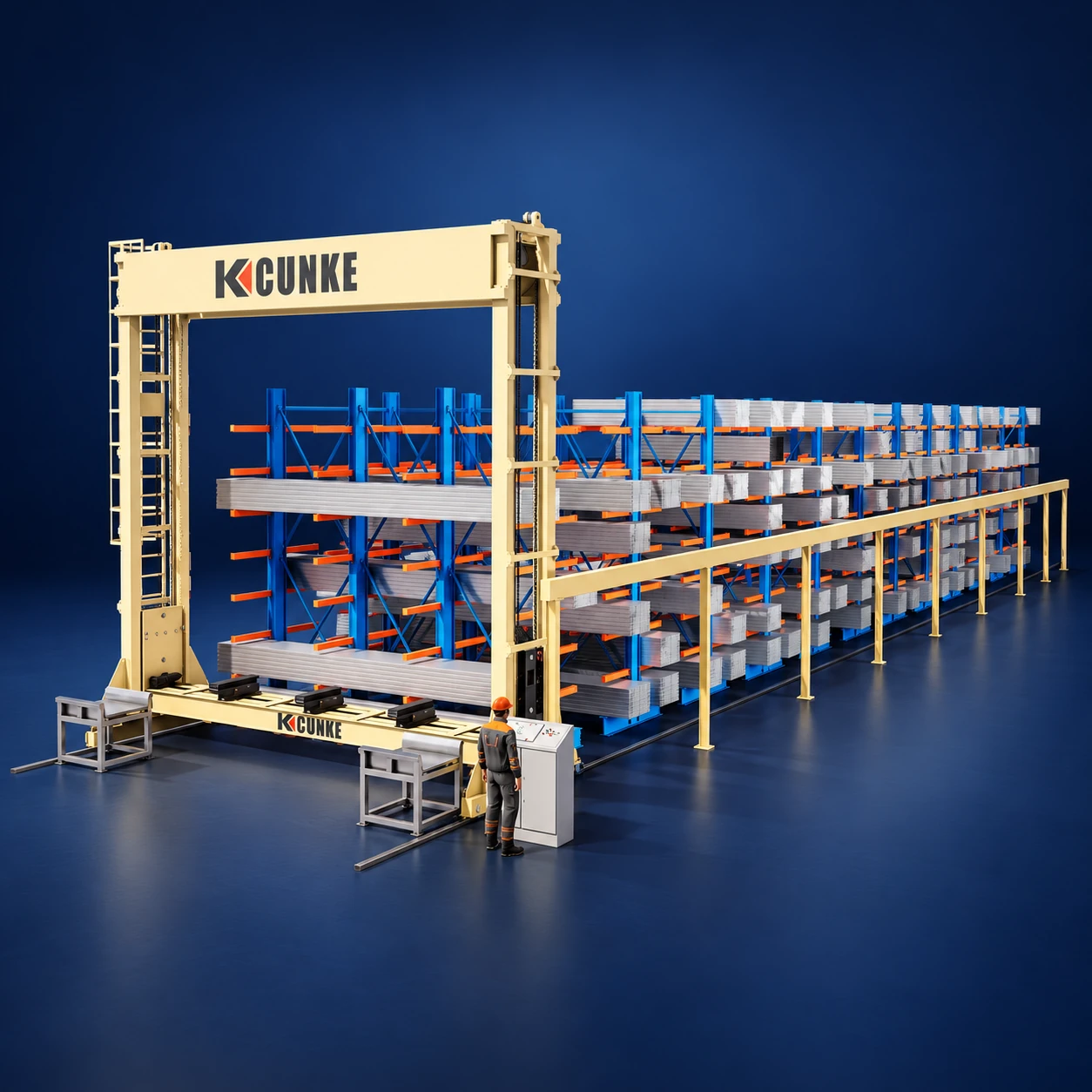


Product Overview
This 12 m gantry storage system combines fixed cantilever racks with a rail-mounted gantry that retrieves loaded carriers. CK METAL STORAGE SOLUTIONS offers a typical 12 m (39.4 ft) / 5,000 kg (11,000 lb) configuration for long-profile stock, designed around the material and site. It is an option for metal service centres and manufacturing stores supplying long stock to cutting operations.
The 5,000 kg figure is a typical storage-unit rating. The quotation must define whether carrier self-weight is included before it can be treated as a usable material payload.
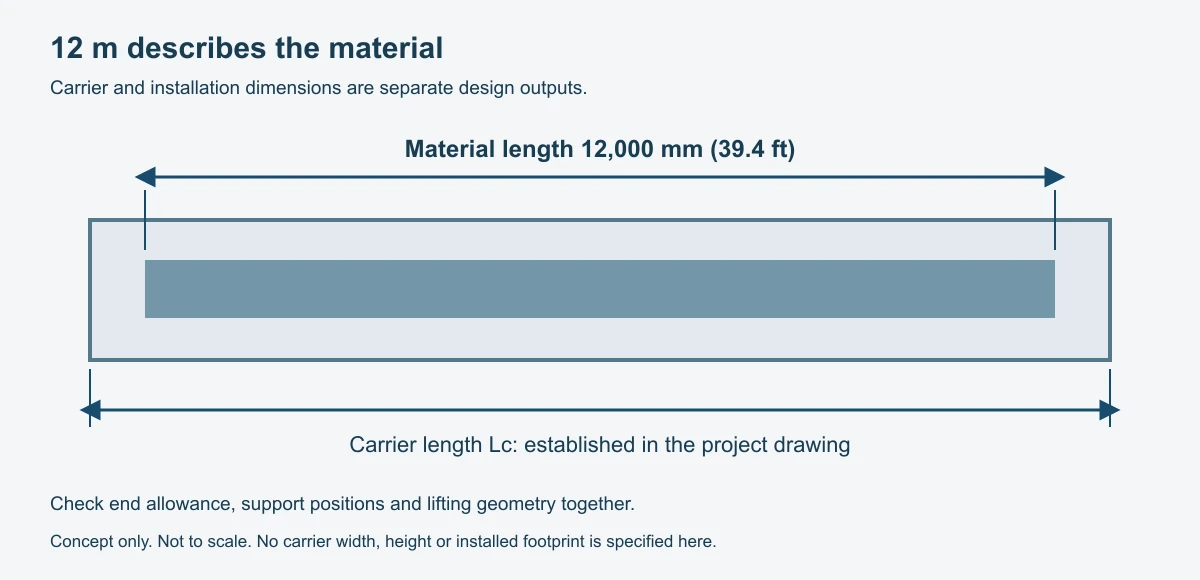
- 12 m (39.4 ft) material length, separate from carrier and machine dimensions.
- 5,000 kg (11,000 lb) typical rating per storage unit, with the carrier-weight basis stated in the specification.
- Fixed storage racks; the gantry moves the load carrier.
- Transfer to a loading station, with the onward route to production defined in the layout.
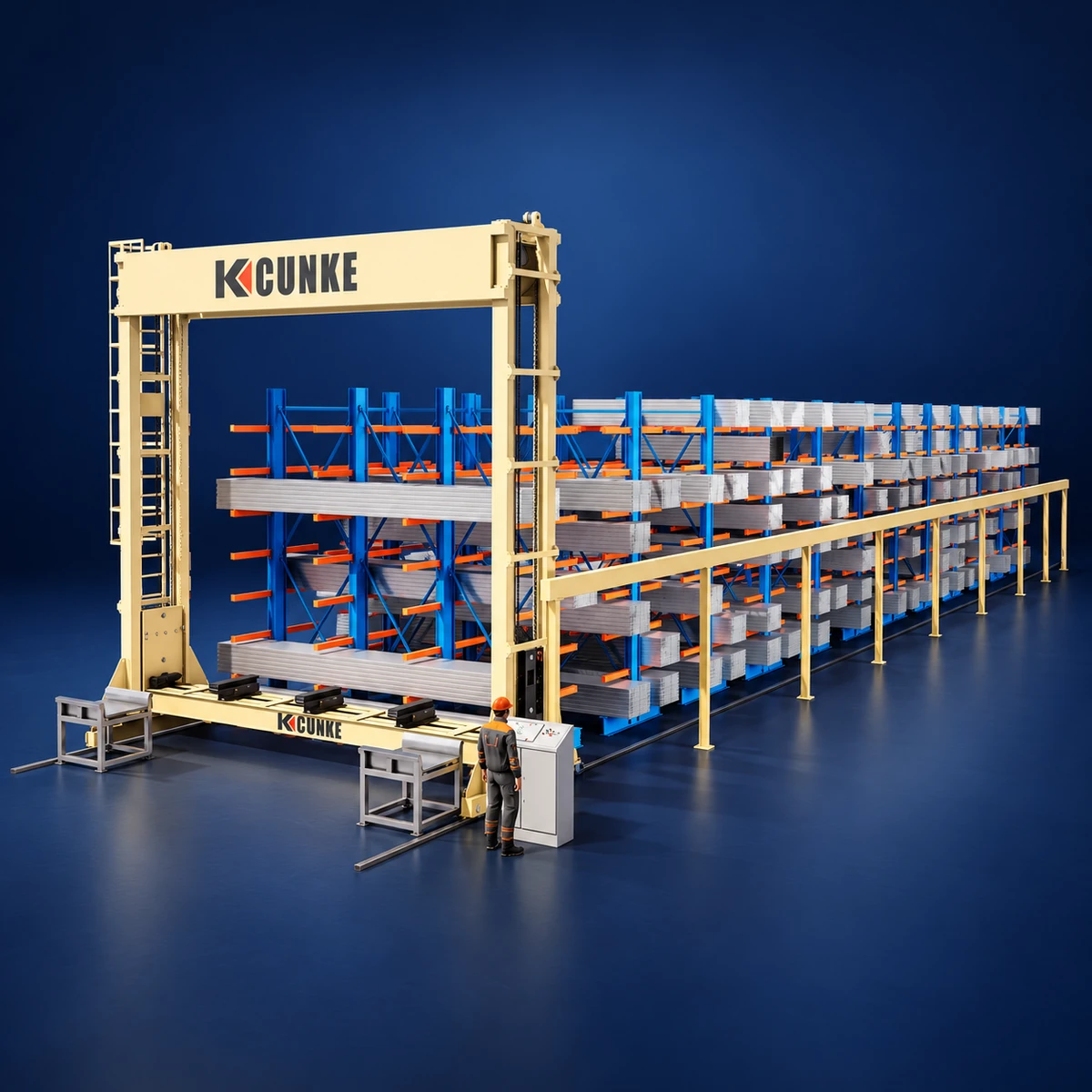
The renderings show the fixed-rack arrangement and illustrative colour options. They do not depict a completed 12 m / 5 t installation. Paint colours can be specified against a RAL reference during the project.
Define the load before choosing the carrier
Start with the actual stock list: section shape, mass per metre, length and number of pieces in each carrier. A lightly filled carrier of large hollow sections can need more space than a heavier, compact load. Total mass alone does not describe the support and restraint needed.
For uniform stock, material mass equals mass per metre multiplied by actual length and piece count. Add separate lines for different sections or lengths. This gives the material total; it does not establish the allowable loading pattern or the net payload after carrier weight.
Our gantry profile storage system lifts the carrier at its ends. The carrier design must therefore connect the material supports to those lifting points. Provide the proposed arrangement of the load, including gaps and mixed lengths, so the design review can cover both rack storage and movement.
Specification for the 12 m fixed-rack proposal
|
Group |
Item |
Proposal basis |
|
Capacity |
Material length |
12 m (39.4 ft), typical configuration |
|
Capacity |
Storage-unit rated load |
5,000 kg (11,000 lb), typical configuration; carrier self-weight basis to be defined in the quotation |
|
Arrangement |
Storage structure |
Fixed cantilever racks with load carriers |
|
Operation |
Carrier movement |
Rail-mounted gantry retrieves and deposits carriers |
|
Control |
Inventory management |
Warehouse management system (WMS); interface scope agreed for the project |
|
Layout |
Carrier and installed dimensions |
Designed from the stock list and site layout; material length is not the overall machine length |
The rating belongs to the specified storage unit. It is not a per-arm rating or a capacity for an entire rack row. Carrier geometry, permitted load distribution and the rated gantry assembly form part of the engineered proposal.
Plan the carrier after a partial pick
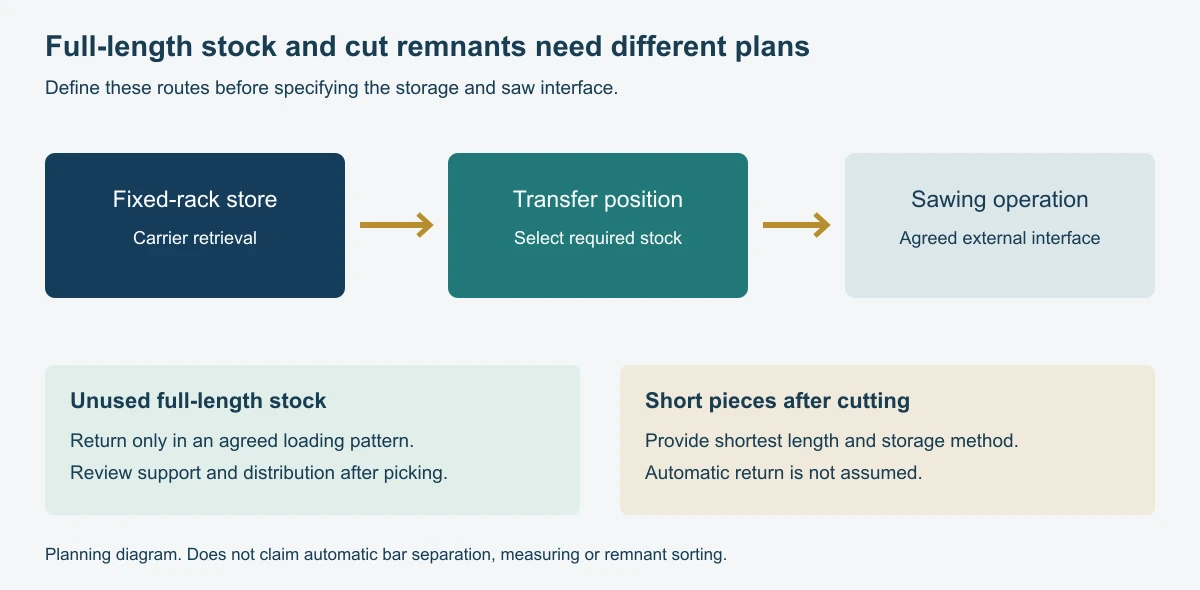
Show the return condition as well as the full carrier. If a cutting job uses only part of a bundle, the remaining full-length pieces may sit differently from the original load. Include that arrangement in the design information, rather than assuming every carrier returns in its delivery condition.
Cut remnants introduce a different question: their length and position may no longer match the support arrangement used for full-length stock. List the shortest pieces you intend to retain and how you want to identify them. Return to the automated store is an option to assess, not an automatic consequence of having spare carrier space.
This is especially relevant where a metal service centre sells both full lengths and cut orders. Separate the stock that will return on a carrier from material that needs another storage route. Do not base the purchase on unconfirmed automatic remnant measurement or sorting.
Set the boundary between storage and sawing
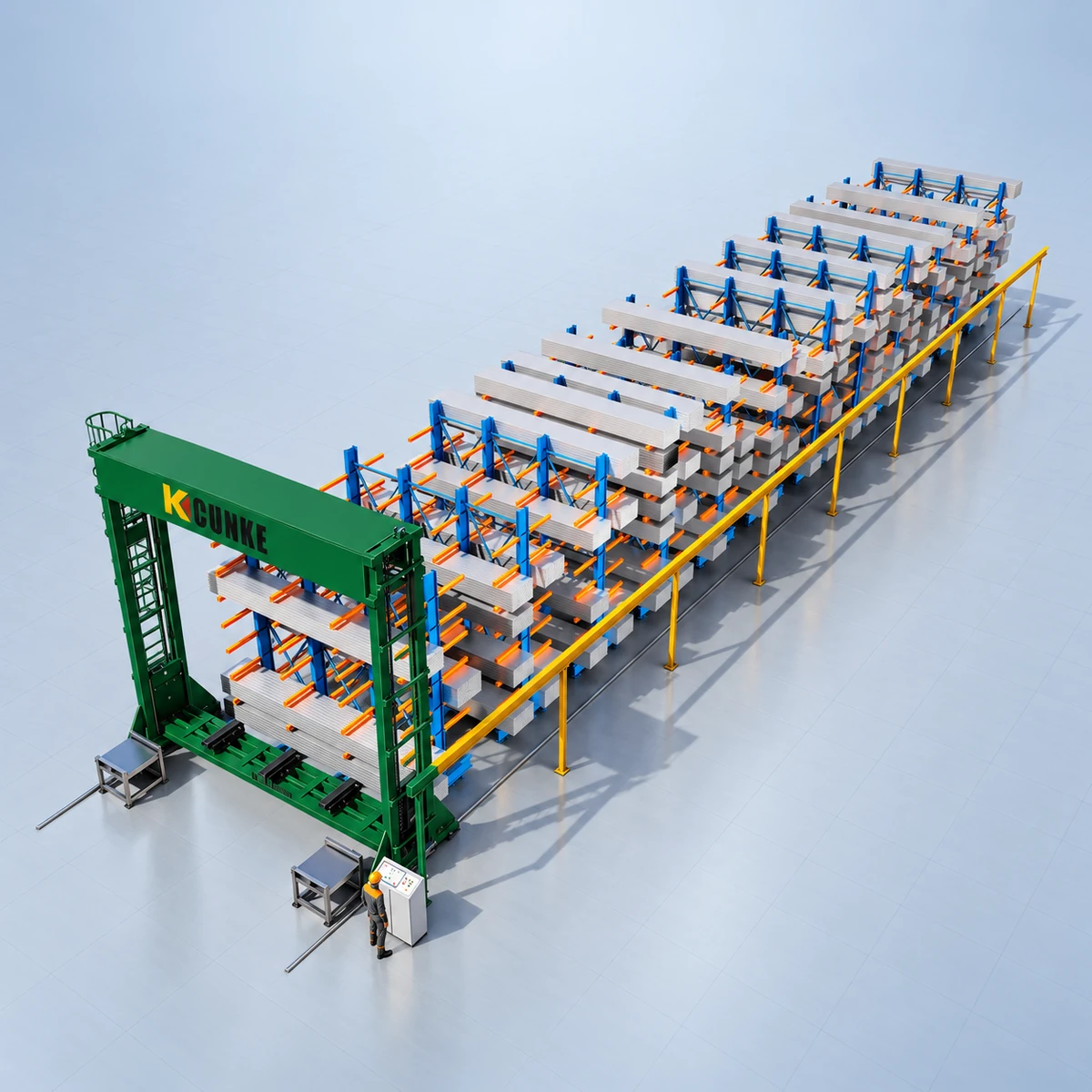
The standard handling principle brings a carrier to the transfer position. Decide who removes the required stock there and how it reaches the saw infeed. That decision determines the transfer equipment, working space and responsibilities on each side of the interface.
Saw feeding, single-bar separation, clamping and short-piece removal need their own equipment and controls. Automated long goods storage does not, by itself, provide those functions. For a proposed connection, send the saw layout and the material movement sequence alongside the storage requirements.
Compare automated carriers with crane access
A crane-access rack can remain a useful alternative when operators need direct access to a level. The choice depends on how material is picked and which lifting equipment is already available.
|
Route |
How stock is accessed |
Main planning question |
|
This fixed-rack gantry store |
Gantry retrieves a carrier to a transfer position |
Can the receiving and production tasks use carrier-based handling? |
|
A rack level extends for lifting from above |
Is suitable lifting equipment available over the picking position? |
|
|
Powered level extension; stock is lifted separately |
Would powered access meet the need without automating carrier transport? |
Automatic carrier retrieval requires electrical power. During an outage, follow the agreed recovery procedure; operators must not retrieve carriers manually. Plan maintenance access with the project team.
Reserve space for the load and the handoff
The site plan must show the full movement envelope, not just a rectangle equal to the stock length. Include columns, the lowest overhead obstruction, receiving access, the transfer position and the route to the saw. Mark any existing crane or forklift movements through that area.
Rail installation can be embedded or surface mounted. Floor reactions, foundations, installed height, electrical demand and service clearances belong to the proposed layout. Values from a smaller installation cannot be used as the design basis for this 5 t configuration.
Personnel must stay clear of the operating area while the equipment works. An aisle-entry alarm is available as an option; its control response must be specified with the access arrangement. An alarm should not be described as proof of an automatic protective stop.
For the wider range of arrangements, see our automated storage configuration overview. The fixed-rack layout on this page is one route within that product family.
Questions before ordering
Send the stock list and a site plan
For a 12 m gantry storage system proposal, send CK METAL STORAGE SOLUTIONS the section drawings, longest and shortest stock, mass per metre, pieces per carrier, maximum material mass and the expected return loads. Add your inventory quantities, retrieval frequency, site drawing, floor information, power supply and saw interface requirements.
We use these inputs to develop the layout and quotation. Automated projects normally have a 60–90 day lead time covering inspection, trial assembly, commissioning work and export packing. Supply includes assembly guidance and engineer support for site commissioning. The standard warranty is one year, with after-sales response within 24 hours.
Request a layout and quotation with your stock data and site photos. There is no fixed footprint or retrieval time quoted for this configuration before that work is done.
Hot Tags: 12 m gantry storage system with fixed cantilever racks, 5,000 kg rated load, China 12 m gantry storage system with fixed cantilever racks, 5,000 kg rated load manufacturers, suppliers, factory