


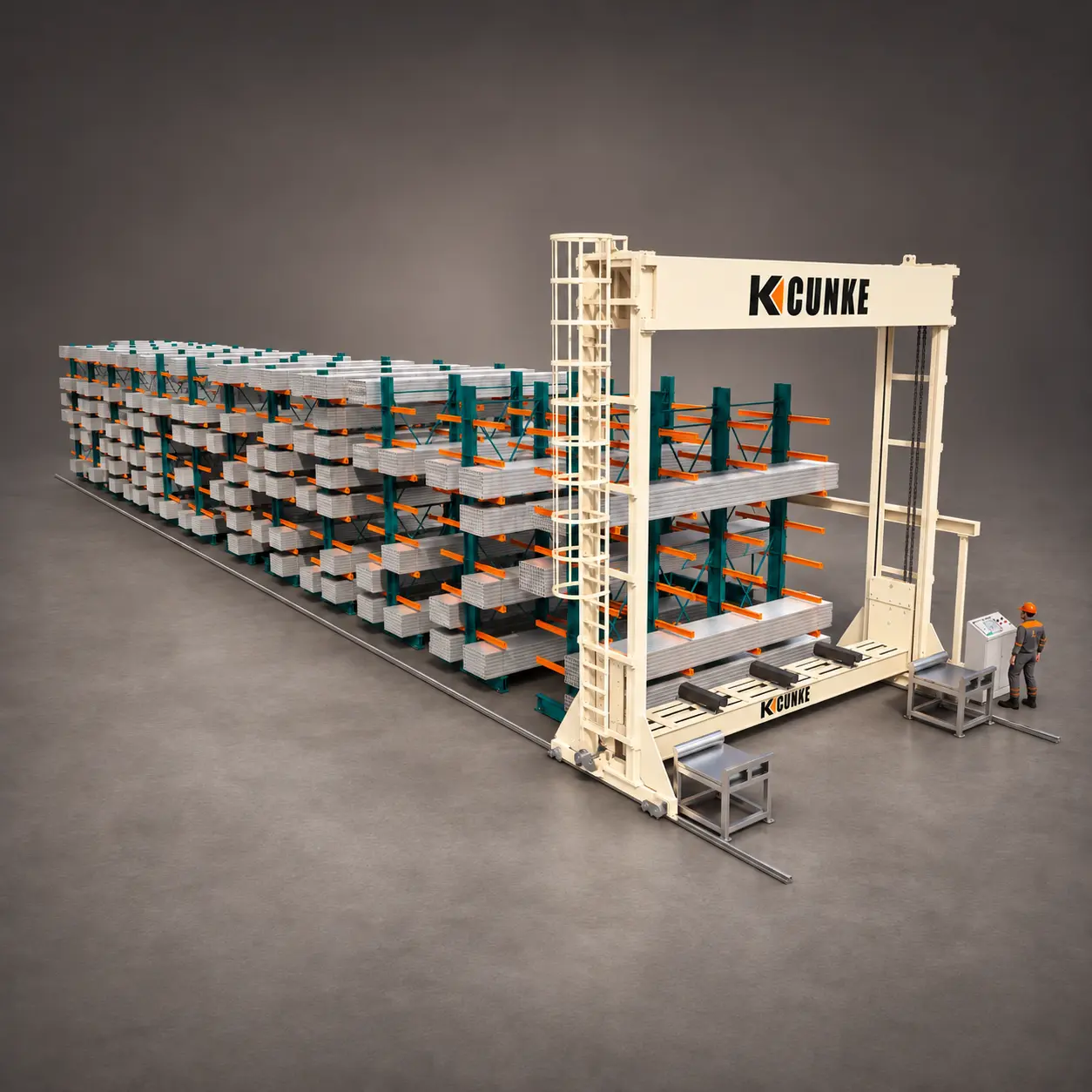


Product Overview
CK METAL STORAGE SOLUTIONS prepares this 12 m mobile cantilever storage proposal for aluminum extrusion plants that need to hold packed long profiles before cutting or fabrication. A typical storage unit is rated at 5,000 kg (11,000 lb) for 12 m (39.4 ft) material. The final quotation defines the carrier self-weight, supported load shape, restraint method, and site layout.
- 12 m refers to the intended material length, not a finished carrier or installation dimension.
- 5,000 kg is a typical rated storage-unit value, not a promised payload for every profile bundle.
- Ordinary cantilever arms do not extend or roll out.
- Rail-guided bases move complete rack rows to open one shared operating aisle.
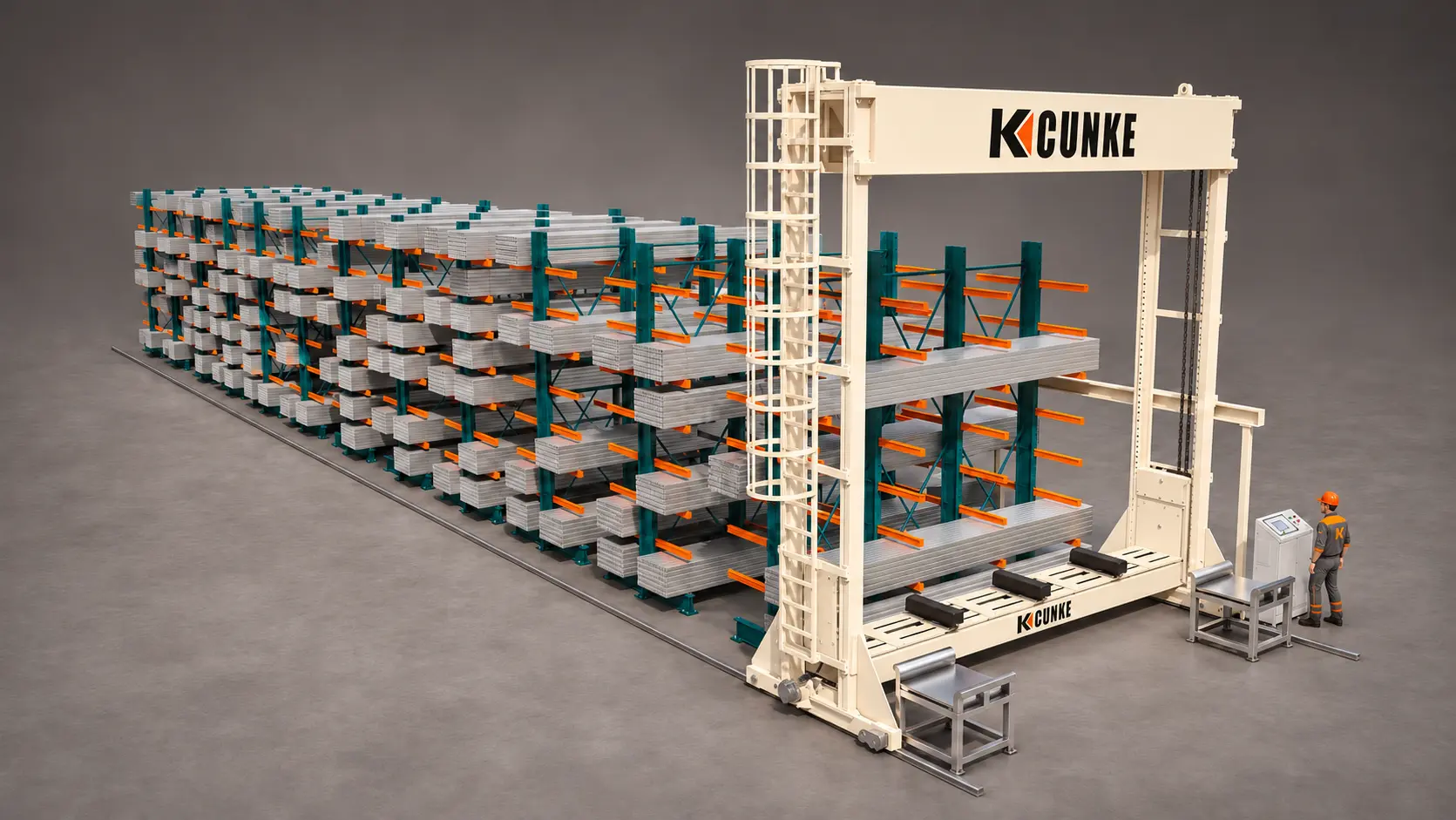
The equipment renderings illustrate a mobile-rack configuration and are not photographs of an aluminum extrusion plant or proof of a specific installed capacity. CUNKE equipment marks remain as shown on the original equipment renderings.
Keep packed extrusion stock identifiable before it enters the mobile aisle
An extrusion plant normally needs to distinguish more than alloy and nominal length before material moves to the saw. The stock list should identify the profile drawing or die reference, alloy and temper where relevant, finish or packaging condition, supplied length, quantity, and the bundle or carrier arrangement. Aluminum extrusion can continue into cutting, punching, machining, bending, or welding, so the next process determines which information must remain available at the transfer position.
This is not a claim that the system automatically chooses a production order, creates kits, or feeds individual bars into a saw. Those functions need a separate controls and handling scope. The gantry handling task in this proposal is carrier retrieval and transfer; individual-profile separation, clamping, and machine infeed must be engineered separately.
Review moisture and packaging before assigning a storage location
Water staining can arise when moisture is trapped between contacting aluminum surfaces or packaging layers. Receiving therefore needs a practical status check: whether the package is wet, whether wrapping has been damaged, and whether material needs a dry or inspection hold before it enters normal stock. A storage system does not remove moisture or repair damaged packaging.
For each incoming load, show the supplied packing arrangement, contact surfaces, separators, and any manufacturer handling instructions. If a wrapped bundle has a profile surface or finish that must not touch an adjacent load, that requirement affects carrier geometry and the proposed restraint approach. Do not infer a liner material, a scratch-free result, or a drying function from automatic carrier handling.
Dry, intact packed bundle: provide profile identity, length, bundle envelope and mass, then assess carrier support and location assignment.
Wet or damaged wrapping: retain a condition record and supplier handling instructions, then hold for the agreed inspection or drying process before normal storage.
Part-used return: provide remaining length, support points, restraint and updated quantity. Assess it separately; a 12 m rating does not approve every short or partial return.
Use the load envelope before using the 5,000 kg rating
A 5,000 kg rating does not establish the number of bundles, profile shapes, or support positions that a carrier may hold. Wide hollow sections, open channels, mixed bundle sizes, dunnage, wrapping, and an uneven partial return can change the occupied envelope and the center of load. Send the packed cross-section and the heaviest intended load, not only a total tonne value.
Material length: typical 12 m (39.4 ft). Confirm the supplied length, overhang, carrier allowance and transfer route.
Rated storage unit: typical 5,000 kg (11,000 lb). Confirm whether carrier tare is included and the agreed loading pattern.
Support and handling: ordinary non-extending cantilever arms support the carrier, while the gantry transfers it. Confirm support spacing, bundle restraint, lifting points, receiving position and downstream handoff.
Mobile layout: rail-guided bases open one common aisle. Confirm row sequence, clearances, rail interface and exclusion area.
Choose mobile rows when shared-aisle access fits the retrieval sequence
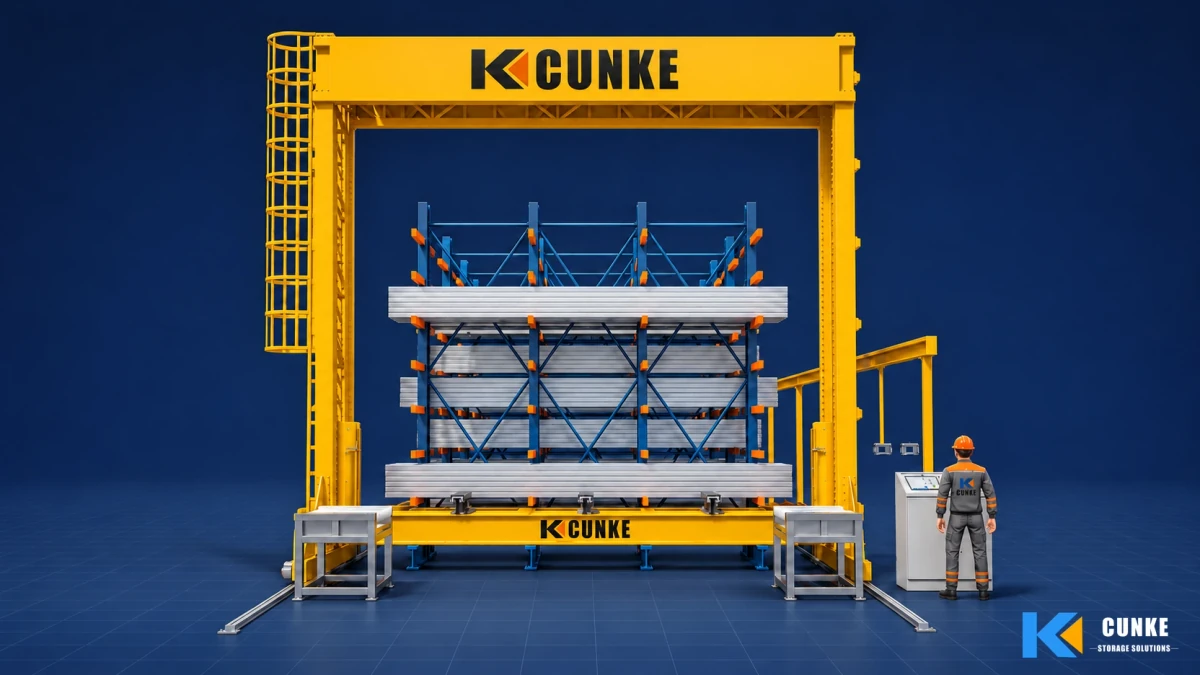
Mobile cantilever storage saves permanent aisle area by moving whole rack rows on rail-guided bases. It does not move the cantilever arms. When a location is requested, the row arrangement opens one shared operating aisle and the gantry retrieves the agreed carrier. The practical question is whether the requested profile sequence can tolerate that shared-aisle pattern.
Fixed cantilever racks with gantry: each rack group has a permanent aisle. Choose this arrangement when permanent access space is preferable for the expected retrieval pattern.
Mobile cantilever racks with gantry: complete rack rows move on rails to open one shared aisle. Choose this arrangement only when stock density and the retrieval sequence justify row movement and shared access.
Neither choice makes a person safe to enter the operating aisle while equipment is working. The confirmed optional aisle-entry alarm is an alarm only; it is not evidence of an automatic protective stop. Access, restart, and exclusion procedures must be defined in the controls review.
Plan the transfer space as part of the extrusion process
The site drawing should show column locations, the lowest overhead obstruction, rail route, receiving or staging position, maintenance access, and the path from transfer to cutting or fabrication. The total installed envelope, foundation reactions, electrical demand, and rail construction are project-specific. Do not borrow a floor-load figure or a 12 m carrier dimension from another installation.
For returns from cutting, define whether the remaining stock is a supported 12 m bundle, a shorter length with its own support arrangement, or scrap outside this system. A long-material store is not automatically a finished-product warehouse, a scrap-management system, or a single-bar feeder.
Questions about 12 m extrusion storage
Send the stock and layout data for an engineering proposal
Send CK METAL STORAGE SOLUTIONS the profile schedule, packed bundle drawings or photographs, maximum bundle mass, proposed carrier load shape, partial-return method, and the building layout. Include required transfer locations and downstream process drawings where a saw or fabrication line is involved.
We can assess a fixed or mobile rack layout, carrier handling route, and ERP or MES interface against the transactions you require. Integration is evaluated for the customer's actual system; it is not assumed from the word automated.
Automated equipment normally has a 60–90 day lead time, including inspection, trial assembly, commissioning work, and export packing. The standard warranty is one year, with after-sales response within 24 hours.
Request a 12 m aluminum extrusion storage layout with the stock schedule and site plan.
Hot Tags: 12 m mobile cantilever storage for aluminum extrusions, 5,000 kg rated load, China 12 m mobile cantilever storage for aluminum extrusions, 5,000 kg rated load manufacturers, suppliers, factory