




Product Overview
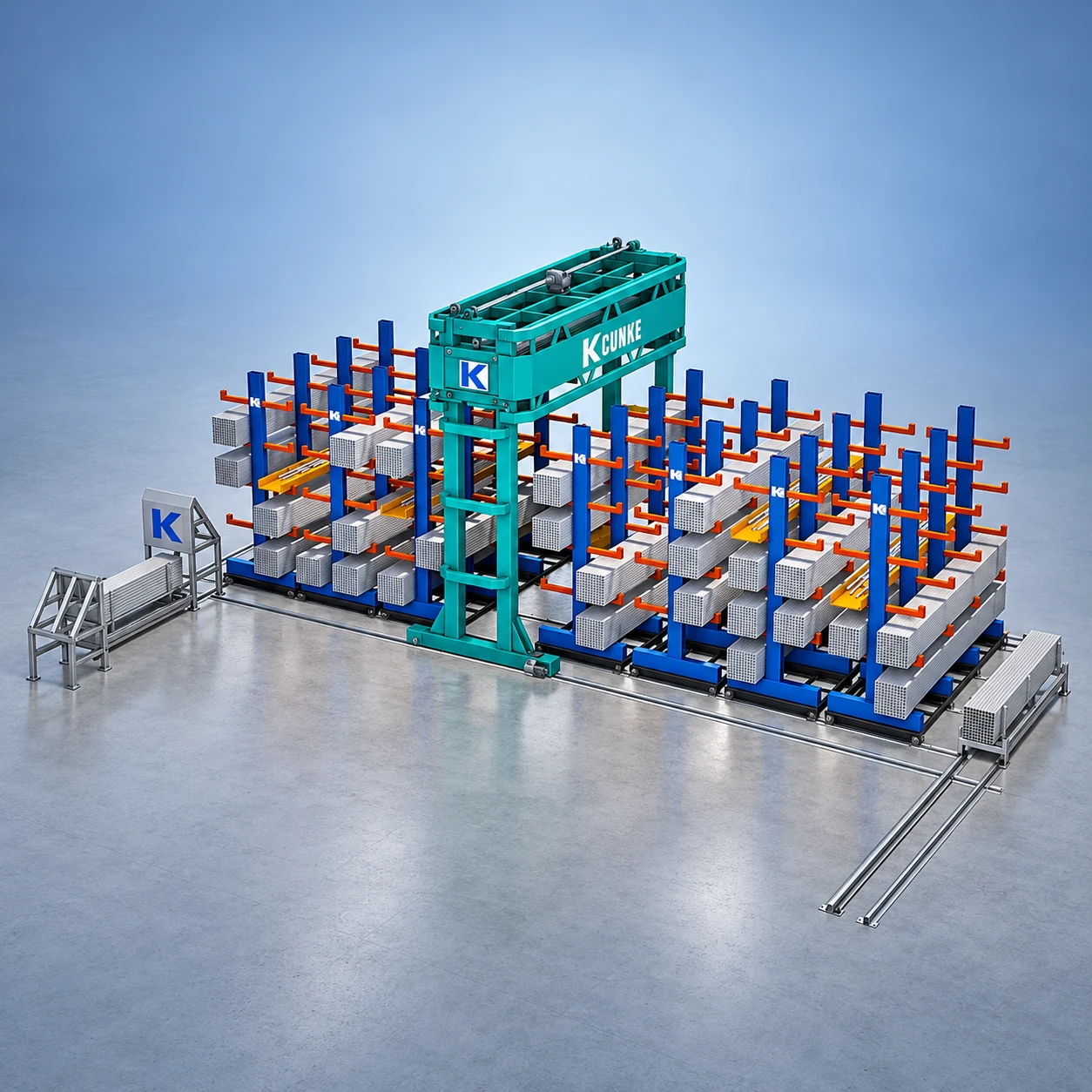
This 12 m automated long material storage proposal pairs mobile cantilever racks with gantry carrier handling. CK METAL STORAGE SOLUTIONS offers a typical 12 m (39.4 ft) / 5,000 kg (11,000 lb) configuration, engineered around the stock and building. It is an option for long-stock stores serving steel cutting and fabrication operations.
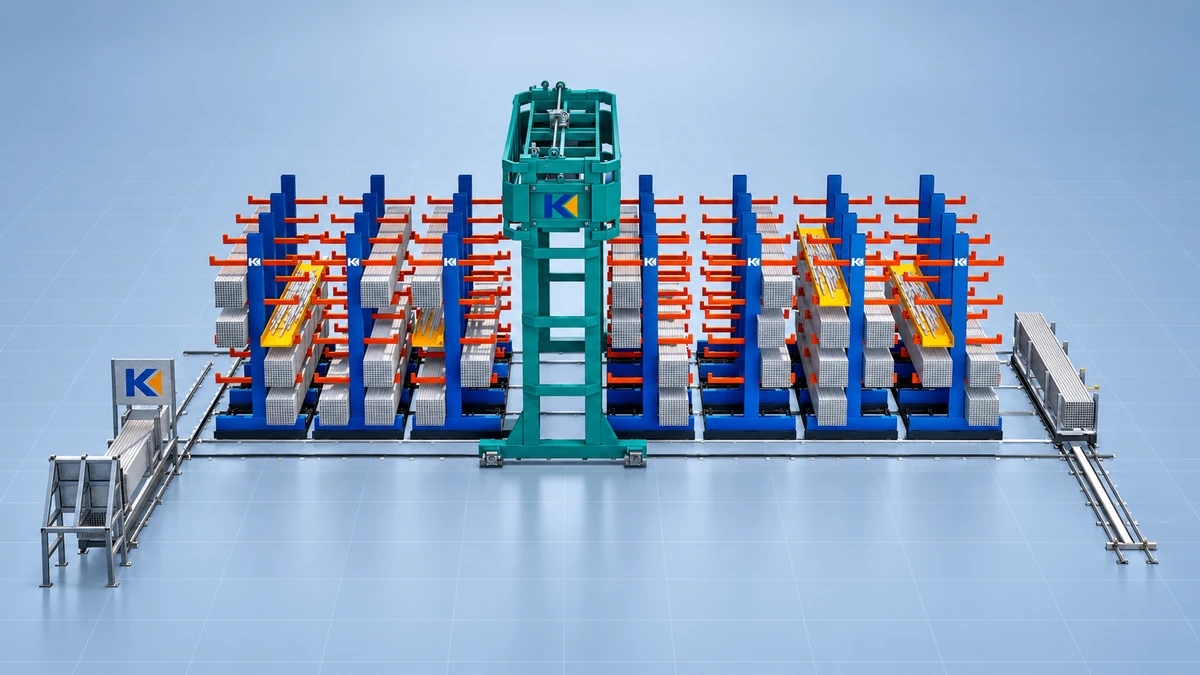
The rack arms are ordinary, non-extending cantilever arms. Rail-guided bases move whole rack rows to open one shared working aisle; the gantry lifts the selected carrier at its ends and brings it to the transfer position.
- 12 m material length, distinct from carrier length and installed machine dimensions.
- 5,000 kg typical rated load per specified storage unit; carrier self-weight treatment must be defined.
- One shared working aisle, opened by moving the rack bases.
- Whole-carrier transfer, with the next handling step designed around your cutting operation.
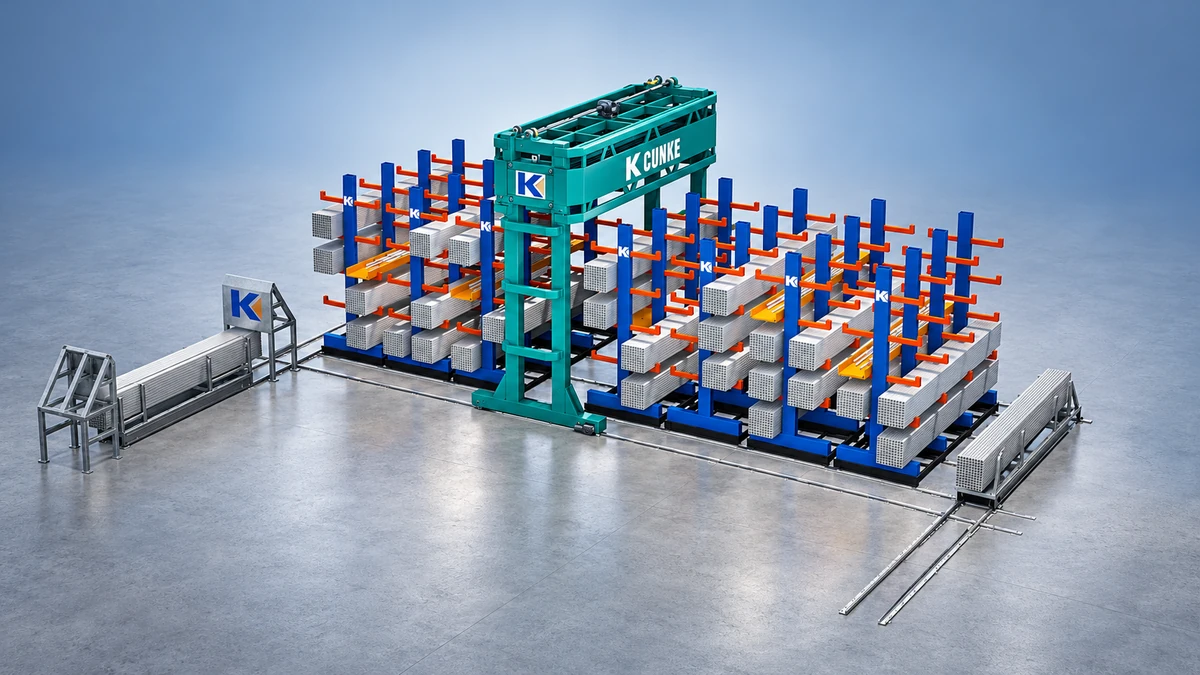
These engineering renderings illustrate the mobile-base arrangement and a teal gantry paint option. They are not installation photographs or dimensional evidence of a completed 12 m / 5 t system. Colours can be agreed against a RAL reference.
Separate the carrier rating from the load on a mobile row
A 5,000 kg storage-unit rating does not specify the total load that a rack row can carry while moving. A row contains several storage positions, and its loading depends on the inventory assigned to them. Send the proposed allocation of stock across the row as well as the heaviest individual carrier.
Keep three descriptions in the enquiry: the metal alone, the carrier with its load, and the stock distribution across the rack row. Carrier self-weight can change the usable metal payload. The row description lets the project team review the mobile assembly and foundation loads without mistaking a single-unit rating for a base rating.
|
Design input |
Information to supply |
Why it matters |
|
Material payload |
Section mass per metre, actual lengths and piece counts |
Establishes the metal mass in the carrier |
|
Loaded carrier |
Carrier weight, lifting points and stock support arrangement |
Defines the unit the gantry must handle |
|
Loaded rack row |
Positions, intended loads and full or partial occupancy |
Defines the inventory carried by the complete moving row |
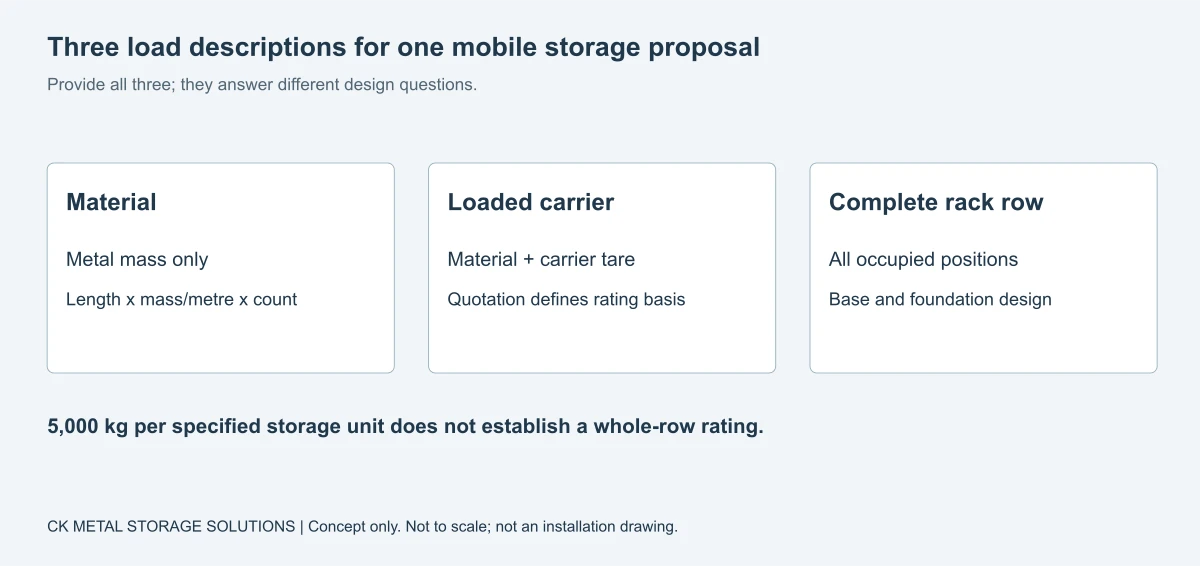
For one stock section, material mass is mass per metre multiplied by length and piece count. Sum the separate entries for mixed stock. That calculation supplies the material total; it does not establish an allowable support pattern or the rating of the mobile base.
Specification basis for the mobile 12 m proposal
|
Group |
Item |
Proposal basis |
|
Capacity |
Material length |
12 m (39.4 ft), typical configuration |
|
Capacity |
Storage-unit rated load |
5,000 kg (11,000 lb); carrier tare basis to be defined in the quotation |
|
Structure |
Cantilever arms |
Ordinary non-extending arms; no roll-out rack levels |
|
Access |
Rack movement |
Whole rows move on rail-guided bases to open one shared aisle |
|
Handling |
Gantry task |
Lifts the carrier at its ends and transports it to a transfer station |
|
Dimensions |
Carrier and installed envelope |
Engineered from stock, row movement and the transfer route |
Carrier geometry and the permitted load arrangement must be agreed for the 5 t configuration. Short pieces, mixed lengths and partly emptied carriers need to appear in the loading information, rather than being treated as smaller versions of a full-length bundle.
Design the transfer route before fixing the store position
A retrieved carrier still needs a route to production. State whether the cutting task removes a full bundle, a few sections or one bar. Then show the lifting device or transfer equipment, its approach to the carrier and the receiving position at the saw.
This matters in a steel service centre that handles both stock-length orders and cut-to-length work. The next movement can be towards dispatch or towards a processing line. Mark both routes if the same transfer position is expected to serve them, and show where a returning carrier can wait.
Storage retrieval ends at the agreed handoff. Saw infeed, single-bar separation, clamping and removal of cut pieces require their own equipment and controls. Include machine drawings and the desired sequence in an interface request; automatic storage alone does not provide those functions.
For a partial pick, describe the carrier as it will return: remaining lengths, position of the stock and restraint. Keep short cut remnants on a separate list with their minimum lengths. Returning them to this store requires an agreed support arrangement and identification method.
Compare the same inventory in fixed and mobile layouts
|
Arrangement |
Rack and aisle behaviour |
Purchase decision |
|
Fixed racks with gantry |
Racks are anchored to the floor, with an aisle between rack groups |
Does permanent access justify the space occupied by the aisles? |
|
Mobile racks with gantry |
Entire rack rows move; one shared aisle opens where required |
Does consolidating the aisles justify row positioning and the planned access sequence? |
Both arrangements use non-extending arms. The choice concerns base movement and aisle allocation, not manual versus powered arm extension. If production requires frequent access at different locations, review that demand against the shared-aisle sequence before choosing the mobile arrangement.
The wider product family is described in our gantry storage configuration overview. Use the same stock allocation and transfer requirements for both layout proposals, including the heaviest intended operating condition.
Reserve the full movement and maintenance envelope
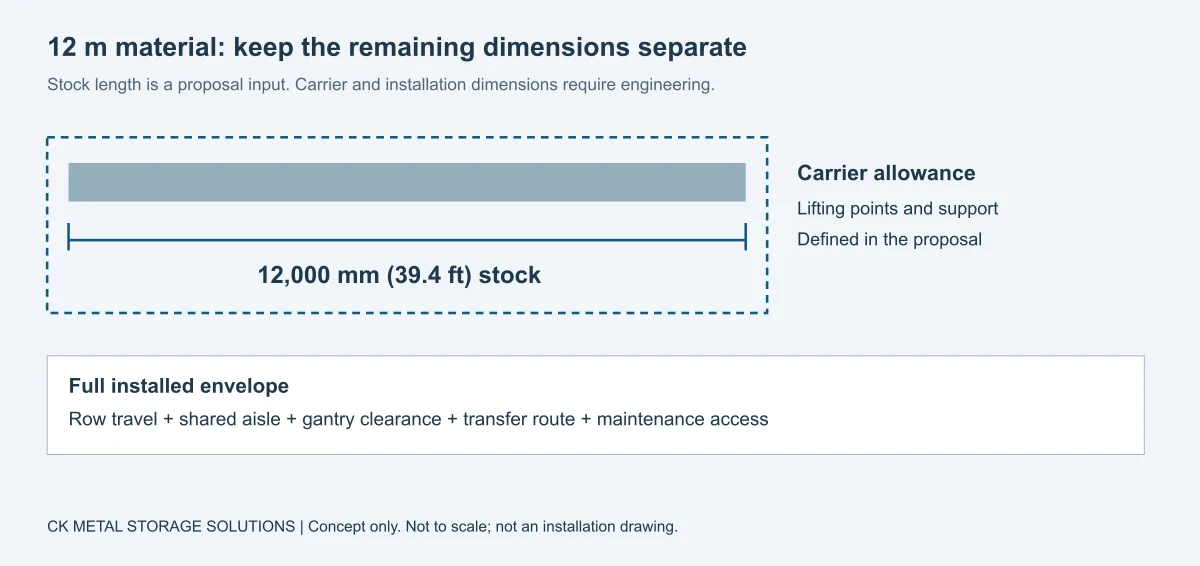
A 12 m load is only one dimension on the site plan. Carrier end allowance, gantry clearance, row travel and transfer equipment need their own space. Show the lowest overhead obstruction, columns, doors and existing vehicle routes before the store position is fixed.
Rails can be embedded or surface mounted. Supply available floor and foundation information for the engineering review; a single floor-area load figure cannot replace the reactions required by the proposed rails and supports. Electrical demand and installation dimensions are established with the layout.
Personnel must remain outside the operating aisle while the equipment works. An aisle-entry alarm is optional, and an automatic protective stop must not be assumed from that alarm. Define access, maintenance and restart procedures with the project team. Direct manual carrier retrieval during a power failure is not permitted.
Questions for a 12 m mobile store
Provide the row loading plan with your enquiry
For a 12 m automated long material storage quotation, send CK METAL STORAGE SOLUTIONS the stock list, section drawings, longest and shortest lengths, carrier loads and intended allocation across the rack rows. Include a site drawing, floor information, power supply and the handling route from the transfer position to production or dispatch.
We can then prepare the layout and quotation around that information. Carrier dimensions, loading limits, row design and the interface scope belong in the agreed proposal.
Automated equipment normally has a 60–90 day lead time covering inspection, trial assembly, commissioning work and export packing. Assembly manuals, videos and engineer support for site commissioning are available. The standard warranty is one year, with an after-sales response within 24 hours.
Send your stock and layout requirements to begin the proposal review.
Hot Tags: 12 m automated long material storage with mobile cantilever racks, 5,000 kg rated load, China 12 m automated long material storage with mobile cantilever racks, 5,000 kg rated load manufacturers, suppliers, factory