


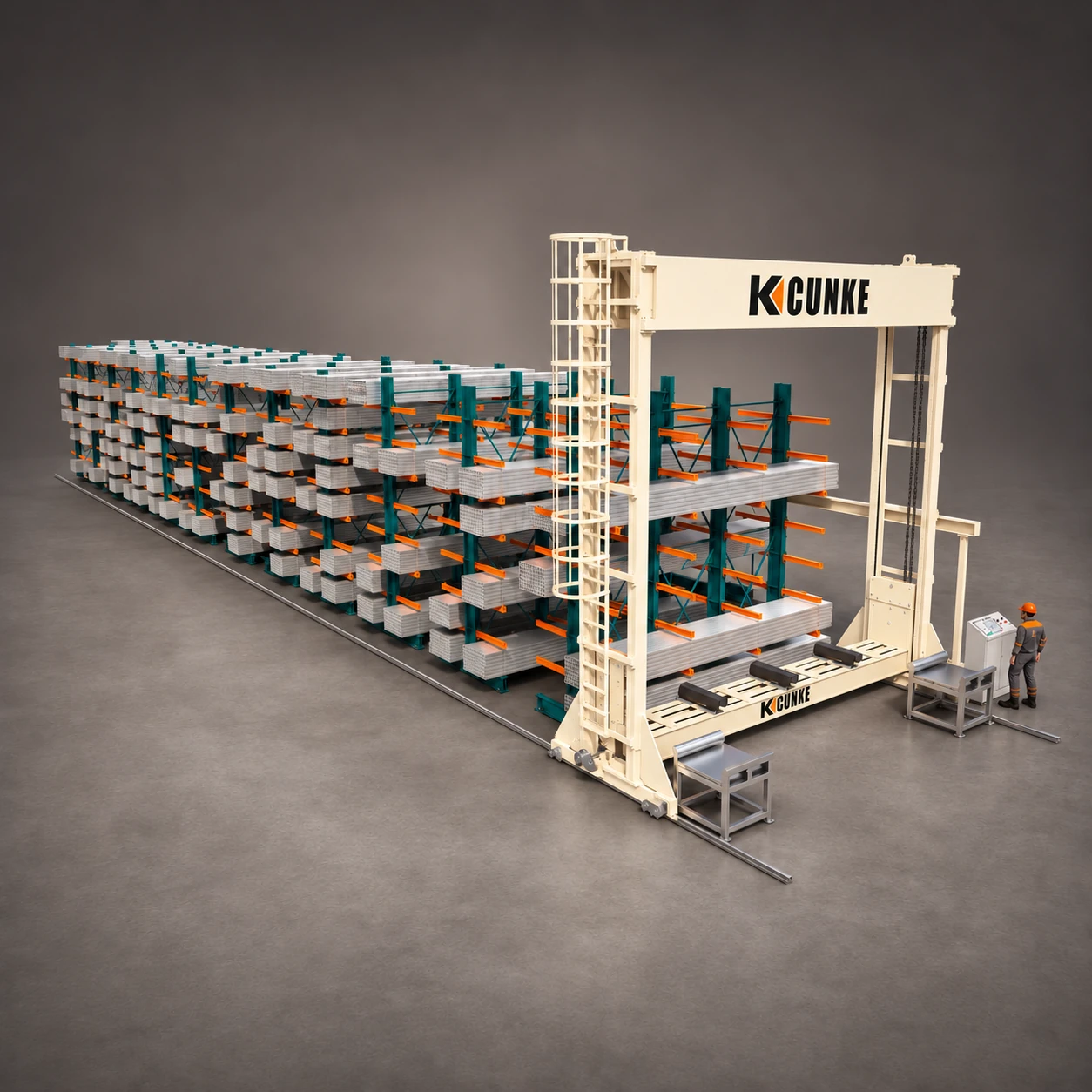


Product Overview
CK METAL STORAGE SOLUTIONS combines gantry handling with WMS location management for long profiles. A common proposal pairs 6 m (19.7 ft) material with a 3,000 kg (6,600 lbs) rated storage unit. The system links physical storage positions with inventory records so operators can request stock from the transfer station.
This configuration suits a profile store that needs recorded storage and retrieval before cutting or fabrication. Final carrier geometry and the treatment of carrier weight are established in the project design; the common rating is not an installation drawing.
- 6 m material length is a common configuration, not the overall machine length.
- 3,000 kg is the common rated storage-unit load; the proposal must state whether carrier tare is included.
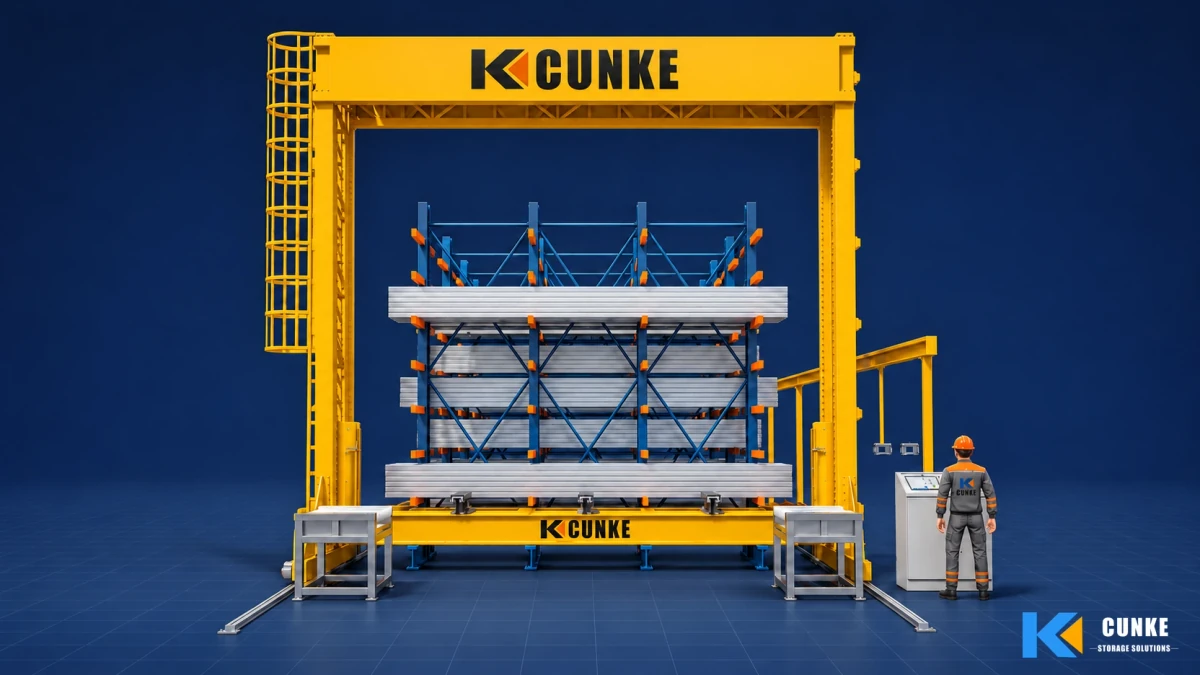
- The gantry handles a carrier from its ends and transfers it between rack positions and the receiving station.
- WMS location records distinguish where stock is stored from which stock is requested.
- Fixed and mobile rack layouts are available; ordinary cantilever arms do not extend.
Keep the storage location separate from the material identity
A location identifies a physical position; it should not become the permanent name of the material stored there. The documented WMS uses unique location codes and supports inventory queries by location, material and batch information. This distinction matters when the same profile occupies several carriers, or a carrier returns to a different position.
Before commissioning, agree how your material codes, carrier labels and location codes relate. A useful acceptance exercise is to store one identified carrier, retrieve it, then return it to another permitted location. Compare the physical carrier with the inventory query after each completed movement. This is a proposed verification exercise, not a claim about a customer's installation.

Complete the movement before closing its inventory record
The documented operating sequence posts the transaction after the gantry reports that the movement is complete. An instruction to retrieve stock and a completed retrieval therefore represent different stages.
- Identify the incoming material and prepare the carrier at the receiving position.
- Issue the storage instruction. The gantry lifts the carrier and places it in the assigned position.
- After the gantry exits and reports completion, the system posts the storage transaction.
- For retrieval, the gantry takes the requested carrier to the receiving station and reports completion before the outbound transaction is posted.
For a store supplying a saw, decide who removes material from the carrier and how that removal is recorded. Carrier retrieval does not by itself measure the pieces removed. If unused full-length material returns, the operating procedure must reconcile the remaining quantity before the next storage instruction. Short remnants need their own approved support and identification arrangement.
Specifications that define the proposal
|
Item |
Common configuration or design basis |
|
Material length |
6 m (19.7 ft); carrier clearance designed separately |
|
Rated load |
3,000 kg (6,600 lbs) per storage unit; tare basis stated in the proposal |
|
Handling |
Gantry lifts the carrier from its ends |
|
Rack structure |
Fixed ordinary cantilever racks or ordinary racks on mobile bases |
|
Inventory scope |
Location management, movement posting and stock queries; project software scope agreed before manufacture |
|
ERP or MES interface |
Supported subject to assessment of the customer's system |
|
Overall dimensions and power |
Designed for the site and selected inventory arrangement |
Do not apply speeds, floor loads or carrier dimensions from a different project to this common 6 m / 3,000 kg proposal. Those values depend on the engineered installation.
Choose the rack layout around the retrieval pattern
Fixed racks keep aisles between rack groups. Mobile bases move whole rack groups along rails to open one shared working aisle; the arms remain fixed within each group.
|
Decision |
Fixed racks with gantry |
Mobile racks with gantry |
|
Aisle arrangement |
Aisles between groups |
One shared aisle opened as required |
|
Motion to consider |
Gantry and carrier movement |
Rack-base movement as well as gantry and carrier movement |
|
WMS planning |
Map each physical position |
Map positions and coordinate the required aisle in the operating sequence |
Use the gantry system overview to review the broader arrangement. For occasional direct crane access, compare a separate manual roll-out rack or motorized roll-out rack. These are different products with extending arms and do not provide the same automated carrier movement.
Define the software handoff without assuming machine integration
ERP or MES connection is assessed against the customer's system. Start with the records to exchange: material identity, requested quantity, storage or retrieval instruction, and completion result. Agree which application owns each record and how operators resolve an incomplete movement before accepting the interface.
The technical specification describes FIFO allocation rules. The configured rule must still reflect usable stock and your production requirements. A batch or material field in a WMS is not proof that every quality restriction, surface finish or customer order rule is already configured.
This is a good fit when you want controlled carrier movements and location-based stock information. It is not the right basis for a requirement that assumes automatic single-profile separation, automatic saw feeding or manual retrieval during a power failure. Those functions are not established by this configuration.
Plan the transfer station and installation together
Send the available floor area, column positions, lowest overhead obstruction and receiving-station location with the stock list. The layout needs space for the complete gantry and carrier travel envelope, installation access and material transfer outside the storage movement area. Floor loading, foundations, rails and supply power are specified for that layout.
Personnel must remain outside the operating aisle during equipment operation. An aisle-entry alarm is optional; an alarm must not be represented as a confirmed automatic stop. The powered jog mode is not a way to operate the system manually without power.
Colour can be selected from the RAL range. The illustrations show colour and layout concepts rather than dimensional proof of a 6 m / 3,000 kg installation. Automation projects typically require 60–90 days including inspection, trial assembly, commissioning preparation and export packing. Final delivery and installation arrangements form part of the proposal.
Questions about WMS location management
Send a stock list and a sample inventory transaction
For a layout and quotation, provide longest and shortest stock lengths, bundle dimensions, actual maximum carrier load, stock quantities and daily movement demand. Include a sample material code, carrier label and current receiving or retrieval record. These show both what the equipment must move and what the software must record. Send your storage and inventory requirements to start the proposal.
Hot Tags: 6 m automated profile storage with wms location management, 3,000 kg rated load, China 6 m automated profile storage with wms location management, 3,000 kg rated load manufacturers, suppliers, factory